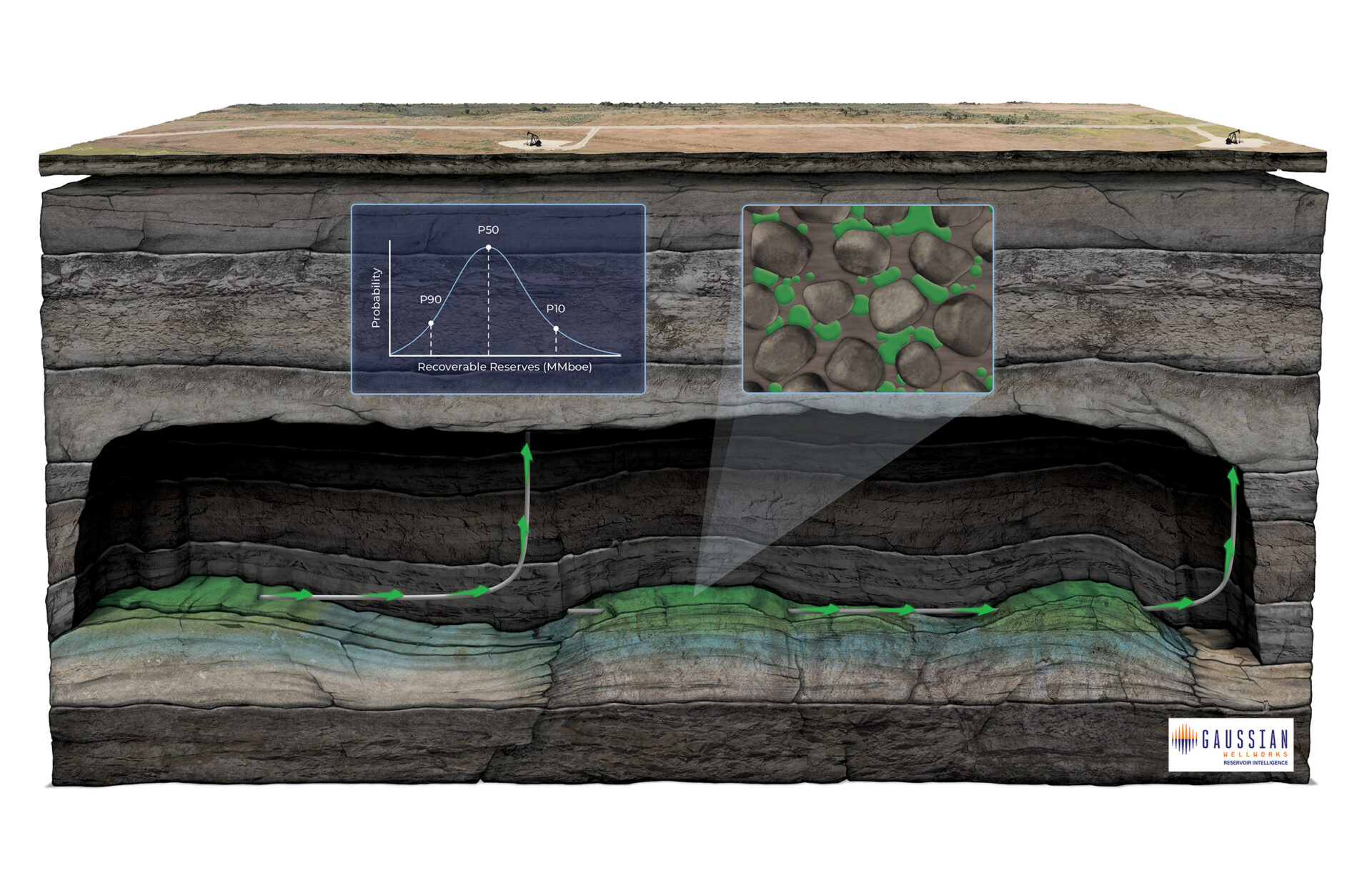
Audit-ready reserve volumes for reporting, financing and development decisions.
Gaussian connects subsurface behavior, production performance, completion design, economics and reporting classification into one uncertainty-aware workflow that generates transparent forecasts and supports reserve estimates that are easier to update, audit and defend.
Gaussian forecasting is built on a closed-form pressure-diffusion solution. A history match constrains hydraulic diffusivity (Dh), then the calibrated model projects well rates and cumulative production.
Deterministic or probabilistic forecasts are converted to reserve estimates only after phase allocation, economic limits, ownership, commerciality, and reporting definitions are applied.
Define the reserve system
Reservoir geometry, stratigraphy, contacts, faults, wells, ownership, development status, and other operating constraints.
Data intake and QC
Collect production, pressure, completion, geologic, PVT, operating cost, price, and ownership data. Screen for shut-ins, operational changes, workovers, interference, and data gaps.
Probabilistic uncertainty
Parameterize uncertainties in reservoir properties, well performance, completion efficiency, recovery factors, costs, and prices. Model correlations and aggregation effects.
Forecast reserve scenarios
History-match production, generate deterministic and P90/P50/P10 forecast ranges using GPT DCA under economic or technical constraints, and identify key risk drivers.
Classification and audit pack
Map volumes to 1P/2P/3P or other required categories under PRMS, SEC, or NI 51-101 and document assumptions, methods, economics, and reproducibility.
Client Receivables
Operators
Well-, reservoir-, field-, and corporate-level reserve tables.
Production forecasts, cumulative recovery, EUR estimates, and sensitivity cases.
1P, 2P, and 3P estimates, with P90, P50, and P10 ranges.
Development comparisons covering well spacing, infill timing, parent–child interference, completion design, and capital allocation.
Portfolio distributions, reserve-movement analysis, risk registers, and executive visuals.
Investors & Lenders
Independent technical summary of reserve volumes, forecast assumptions, and economics.
Downside, base, and upside reserve and valuation cases.
Risk commentary on undeveloped inventory, parent-child effects, development timing, and key reserve drivers.
Technical support for reserve-based lending and borrowing-capacity assessments.
Due-diligence materials for M&A, IPOs, financings, and asset transactions.
Investor-ready portfolio distributions and traceable links between reserves, production performance, and economics.
Distributions linking production performance, forecast uncertainty, reserves, and valuation.
Regulators & Auditors
Classification and disclosure support under applicable SPE-PRMS, SEC, or NI 51-101 requirements.
Effective-date assumptions register and audit-ready technical documentation.
Certification or audit-opinion letters, CPR sections, and third-party review notes, as applicable.
Quality, consistency, and reserve-movement checks covering production data, ownership, development plans, and developed or undeveloped status.
Proven Results in the Field
Probabilistic Reserves Estimation with Gaussian DCA (Wolfcamp Shale)
Gaussian benchmarked physics-based DCA against Arps on two Wolfcamp wells, reducing residual squared error by 99.99% and 98.35%, respectively. It generated 40-year oil EURs of 201 and 340 Mbbl and used field-calibrated diffusivity distributions to quantify reserve uncertainty.
Read more peer-reviewed studies further demonstrating the reliability and technical validity of Gaussian technology.
Computation of pressure depletion and productivity of multi-fractured wells with variable fracture spacing using fast and accurate solution method
Tian, Y. and Weijermars, R.March 1, 2026Petroleum Research
This study presents a fast method that can model the pressure depletion around hydraulically fractured wells accurately. The Gaussian Pressure-Transient (GPT) method has infinite resolution, because no discrete-grid computations are required − the method solves the pressure field using closed-form solutions. After extensive testing on field cases and calibration against other (independent) solution-methods, it appeared that the pressure interference of multiple fractures represented by pressure transients − in the early phases of pressure advance − behaves according to the traditional superposition-method. However, when pressure interference advances, the traditional superposition method gives increasingly unrealistic and inaccurate results. Therefore, the traditional superposition method typically used for steady-state, needs adjustment when applied to transient systems, modeled here with Gaussian pressure-diffusion probability-density functions. The new solutions are valid for the advance of pressure changes both in the early and late stages of the well-life. A second new insight presented here is that the superposition of multiple fractures using Gaussian solutions (together with pressure-gradient computations and application of Darcy’s) can accurately forecast the future production rate and cumulative production of the well over the economic well-life, accounting for the impact of fracture-spacing changes. The new method is validated by history-matching of our Gaussian forecasts using real well-data to constrain specific reservoir properties (hydraulic diffusivity) and completion parameters (fracture half-lengths), and then was benchmarked against independent simulations with CMG-IMEX.This study presents a fast method that can model the pressure depletion around hydraulically fractured wells accurately. The Gaussian Pressure-Transient (GPT) method has infinite resolution, because no discrete-grid computations are required − the method solves the pressure field using closed-form solutions. After extensive testing on field cases and calibration against other (independent) solution-methods, it appeared that the pressure interference of multiple fractures represented by pressure transients − in the early phases of pressure advance − behaves according to the traditional superposition-method. However, when pressure interference advances, the traditional superposition method gives increasingly unrealistic and inaccurate results. Therefore, the traditional superposition method typically used for steady-state, needs adjustment when applied to transient systems, modeled here with Gaussian pressure-diffusion probability-density functions. The new solutions are valid for the advance of pressure changes both in the early and late stages of the well-life. A second new insight presented here is that the superposition of multiple fractures using Gaussian solutions (together with pressure-gradient computations and application of Darcy’s) can accurately forecast the future production rate and cumulative production of the well over the economic well-life, accounting for the impact of fracture-spacing changes. The new method is validated by history-matching of our Gaussian forecasts using real well-data to constrain specific reservoir properties (hydraulic diffusivity) and completion parameters (fracture half-lengths), and then was benchmarked against independent simulations with CMG-IMEX.
Pressure-Transient Solutions for Unbounded and Bounded Reservoirs Produced and/or Injected via Vertical Well-Systems with Constant Bottomhole-Pressures
Weijermars, R., and Afagwu, C.August 28, 2024MDPI Fluids
Various analytical solutions for computing production and injection-induced pressure changes in aquifers and oil reservoirs have been derived over the past century. All prior solutions assumed a constant well rate as the boundary condition. However, in many practical situations, the fluid withdrawal from and/or injection into such subsurface reservoirs occurs with the aid of pump devices that maintain a constant bottomhole pressure in the well. Until now, how the well rate will decline over time, based on the pressure difference in the well relative to the initial reservoir pressure, could not be rapidly computed analytically (using the diffusivity as the key governing system parameter), because no concise expression had been derived with the boundary condition of a constant bottomhole pressure. The present study shows how the pressure diffusion equation can be readily solved for wells acting as sinks and sources with a constant bottomhole pressure condition. We consider both fractured and unfractured completions, as well as injection and production modes. The new solutions do not require an elaborate time-stepped pressure-matching procedure as in nodal analysis, the only other physics-based analytical method currently available to compute the well rate decline when a constant bottomhole pressure production system is used, which unlike our new method proposed here is limited to single well systems.Various analytical solutions for computing production and injection-induced pressure changes in aquifers and oil reservoirs have been derived over the past century. All prior solutions assumed a constant well rate as the boundary condition. However, in many practical situations, the fluid withdrawal from and/or injection into such subsurface reservoirs occurs with the aid of pump devices that maintain a constant bottomhole pressure in the well. Until now, how the well rate will decline over time, based on the pressure difference in the well relative to the initial reservoir pressure, could not be rapidly computed analytically (using the diffusivity as the key governing system parameter), because no concise expression had been derived with the boundary condition of a constant bottomhole pressure. The present study shows how the pressure diffusion equation can be readily solved for wells acting as sinks and sources with a constant bottomhole pressure condition. We consider both fractured and unfractured completions, as well as injection and production modes. The new solutions do not require an elaborate time-stepped pressure-matching procedure as in nodal analysis, the only other physics-based analytical method currently available to compute the well rate decline when a constant bottomhole pressure production system is used, which unlike our new method proposed here is limited to single well systems.
Probabilistic Production Forecasting and Reserves Estimation: Benchmarking Gaussian Decline Curve Analysis Against the Traditional Arps Method (Wolfcamp Shale Case Study)
Pratama, M.A. Al Qoroni, O., Rahmatullah, I.K., Jameel, M.F., and Weijermars, R.January 1, 2024Geoenergy Science and Engineering
This study provides novel insights into how a relatively new, Gaussian DCA method may be used to forecast well rates and estimate resource volumes produced from unconventional reservoirs. Production data of two wells in the Wolfcamp Shale Formation (Midland Basin, West Texas) were history-matched using both the Arps and Gaussian DCA method. Production forecasts were constructed based on the history-matching of historical production data, and the estimated ultimate recovery (EUR) was determined from the cumulative production at the end of the economic well-life (assumed here to be 40 years). Comparing the results of the conventional Arps and new Gaussian DCA method, we found the Gaussian DCA technique compared favorably to the conventional Arps method, the former being faster and having less error in the history-matching process. The traditional Arps history-matching technique is always initiated with very high initial well rates. In contrast, the very first spike in the actual production rates can be accurately captured by the Gaussian DCA method. The hydraulic diffusivity parameter that was obtained from the history-matching in the Gaussian DCA method was also compared with a calculated diffusivity using primary values obtained from laboratory and well log data. The hydraulic diffusivity parameter obtained from the Gaussian history-match of field data is at the lower side of the probabilistic values calculated based on the laboratory and well log data. A probabilistic regression analysis was applied and the estimated values’ distribution was then adjusted to match the values from the history matches as a basis for the final probabilistic EUR estimations for the study wells. Separately, a bootstrapping method can be used to produce probabilistic EUR estimates based on single well data.This study provides novel insights into how a relatively new, Gaussian DCA method may be used to forecast well rates and estimate resource volumes produced from unconventional reservoirs. Production data of two wells in the Wolfcamp Shale Formation (Midland Basin, West Texas) were history-matched using both the Arps and Gaussian DCA method. Production forecasts were constructed based on the history-matching of historical production data, and the estimated ultimate recovery (EUR) was determined from the cumulative production at the end of the economic well-life (assumed here to be 40 years). Comparing the results of the conventional Arps and new Gaussian DCA method, we found the Gaussian DCA technique compared favorably to the conventional Arps method, the former being faster and having less error in the history-matching process. The traditional Arps history-matching technique is always initiated with very high initial well rates. In contrast, the very first spike in the actual production rates can be accurately captured by the Gaussian DCA method. The hydraulic diffusivity parameter that was obtained from the history-matching in the Gaussian DCA method was also compared with a calculated diffusivity using primary values obtained from laboratory and well log data. The hydraulic diffusivity parameter obtained from the Gaussian history-match of field data is at the lower side of the probabilistic values calculated based on the laboratory and well log data. A probabilistic regression analysis was applied and the estimated values’ distribution was then adjusted to match the values from the history matches as a basis for the final probabilistic EUR estimations for the study wells. Separately, a bootstrapping method can be used to produce probabilistic EUR estimates based on single well data.
Production Forecasting of Unruly Geoenergy Extraction Wells Using Gaussian Decline Curve Analysis
Weijermars, R.September 28, 2023Geofluids
Fast and rigorous well performance evaluation is made possible by new solutions of the pressure diffusion equation. The derived Gaussian pressure transient (GPT) solutions can be practically formulated as a decline curve analysis (DCA) equation for history matching of historic well rates to then forecast the future well performance and estimate the remaining reserves. Application in rate transient analysis (RTA) mode is also possible to estimate fracture half-lengths. Because GPT solutions are physics-based, these can be used for production forecasting as well as in reservoir simulation mode (by computing the spatial and temporal pressure gradients everywhere in the reservoir section drained by either an existing or a planned well). The present paper focuses on the physics-based production forecasting of so-called “unruly” wells, which at first seem to have production behavior noncompliant with any DCA curve. Four shale wells (one from the Utica, Ohio; one from the Eagle Ford Formation, East Texas; and two from the Wolfcamp Formation, West Texas) are analyzed in detail. Physics-based adjustments are made to the Gaussian DCA history matching process, showing how the production rate of these wells is fully compliant with the rate implied by the hydraulic diffusivity of the reservoir sections where these wells drain from.Fast and rigorous well performance evaluation is made possible by new solutions of the pressure diffusion equation. The derived Gaussian pressure transient (GPT) solutions can be practically formulated as a decline curve analysis (DCA) equation for history matching of historic well rates to then forecast the future well performance and estimate the remaining reserves. Application in rate transient analysis (RTA) mode is also possible to estimate fracture half-lengths. Because GPT solutions are physics-based, these can be used for production forecasting as well as in reservoir simulation mode (by computing the spatial and temporal pressure gradients everywhere in the reservoir section drained by either an existing or a planned well). The present paper focuses on the physics-based production forecasting of so-called “unruly” wells, which at first seem to have production behavior noncompliant with any DCA curve. Four shale wells (one from the Utica, Ohio; one from the Eagle Ford Formation, East Texas; and two from the Wolfcamp Formation, West Texas) are analyzed in detail. Physics-based adjustments are made to the Gaussian DCA history matching process, showing how the production rate of these wells is fully compliant with the rate implied by the hydraulic diffusivity of the reservoir sections where these wells drain from.
Gaussian Decline Curve Analysis of Hydraulically Fractured Wells in Shale Plays: Examples from HFTS-1 (Hydraulic Fracture Test Site-1, Midland Basin, West Texas)
Weijermars, R.September 2, 2022MDPI Energies
The present study shows how new Gaussian solutions of the pressure diffusion equation can be applied to model the pressure depletion of reservoirs produced with hydraulically multi-fractured well systems. Three practical application modes are discussed: (1) Gaussian decline curve analysis (DCA), (2) Gaussian pressure-transient analysis (PTA) and (3) Gaussian reservoir models (GRMs). The Gaussian DCA is a new history matching tool for production forecasting, which uses only one matching parameter and therefore is more practical than hyperbolic DCA methods. The Gaussian DCA was compared with the traditional Arps DCA through production analysis of 11 wells in the Wolfcamp Formation at Hydraulic Fracture Test Site-1 (HFTS-1). The hydraulic diffusivity of the reservoir region drained by the well system can be accurately estimated based on Gaussian DCA matches. Next, Gaussian PTA was used to infer the variation in effective fracture half-length of the hydraulic fractures in the HFTS-1 wells. Also included in this study is a brief example of how the full GRM solution can accurately track the fluid flow-paths in a reservoir and predict the consequent production rates of hydraulically fractured well systems. The GRM can model reservoir depletion and the associated well rates for single parent wells as well as for arrays of multiple parent–parent and parent–child wells.The present study shows how new Gaussian solutions of the pressure diffusion equation can be applied to model the pressure depletion of reservoirs produced with hydraulically multi-fractured well systems. Three practical application modes are discussed: (1) Gaussian decline curve analysis (DCA), (2) Gaussian pressure-transient analysis (PTA) and (3) Gaussian reservoir models (GRMs). The Gaussian DCA is a new history matching tool for production forecasting, which uses only one matching parameter and therefore is more practical than hyperbolic DCA methods. The Gaussian DCA was compared with the traditional Arps DCA through production analysis of 11 wells in the Wolfcamp Formation at Hydraulic Fracture Test Site-1 (HFTS-1). The hydraulic diffusivity of the reservoir region drained by the well system can be accurately estimated based on Gaussian DCA matches. Next, Gaussian PTA was used to infer the variation in effective fracture half-length of the hydraulic fractures in the HFTS-1 wells. Also included in this study is a brief example of how the full GRM solution can accurately track the fluid flow-paths in a reservoir and predict the consequent production rates of hydraulically fractured well systems. The GRM can model reservoir depletion and the associated well rates for single parent wells as well as for arrays of multiple parent–parent and parent–child wells.
Production Rate of Multi-Fractured Wells Modeled with Gaussian Pressure Transients
Weijermars, R.March 1, 2022Journal of Petroleum Science and Engineering
This study presents new pressure transient solutions, illustrated with some examples of the vast practical application potential. Gaussian pressure transients (GPT) are derived here to quantify the temporal and spatial propagation of instantaneous pressure changes in porous media, as initiated from cylindrical sources (vertical wells) and planar sources (hydraulic fractures). After solving the scalar pressure field in the reservoir space, and adequately accounting for the interference of the various pressure fronts by mathematical integration and superposition, the resulting pressure gradients solve for the velocity field in the reservoir space. Unique for GPT solutions is that the well rate, unlike in the traditional well-testing equations, does not appear as an input. Applying Darcy’s Law, the fluid flux from the reservoir into the well and hydraulic fractures can be directly computed from the GPT solutions. The closed-form production-forecasting model can be implemented either in matrix-coded flow-visualizations of pressure depletion and flow paths for reservoir sections or in grid-less spreadsheet solutions to instantaneously generate production profiles for wells in any type of fluid injection/extraction project (water production, geothermal energy extraction, hydrocarbon production, and fluid disposal wells). Additionally, the Gaussian method also is suitable for physics-based decline curve analysis. The practical examples included in this study are for Eagle Ford shale oil and Marcellus dry gas wells. The hydraulic diffusivities are constrained by the field data, and range between 2.36 x10⁻¹⁰ and 3.48 x10⁻¹⁰ m2 s−1 for the Eagle Ford Formation; for the Marcellus the range is 3.64×10⁻⁹ to 5.67×10⁻⁸ m2 s−1. The breakthrough solution method of Gaussian pressure transients is placed in the context of past and present modeling approaches for shale plays developed with multi-fractured wells.This study presents new pressure transient solutions, illustrated with some examples of the vast practical application potential. Gaussian pressure transients (GPT) are derived here to quantify the temporal and spatial propagation of instantaneous pressure changes in porous media, as initiated from cylindrical sources (vertical wells) and planar sources (hydraulic fractures). After solving the scalar pressure field in the reservoir space, and adequately accounting for the interference of the various pressure fronts by mathematical integration and superposition, the resulting pressure gradients solve for the velocity field in the reservoir space. Unique for GPT solutions is that the well rate, unlike in the traditional well-testing equations, does not appear as an input. Applying Darcy’s Law, the fluid flux from the reservoir into the well and hydraulic fractures can be directly computed from the GPT solutions. The closed-form production-forecasting model can be implemented either in matrix-coded flow-visualizations of pressure depletion and flow paths for reservoir sections or in grid-less spreadsheet solutions to instantaneously generate production profiles for wells in any type of fluid injection/extraction project (water production, geothermal energy extraction, hydrocarbon production, and fluid disposal wells). Additionally, the Gaussian method also is suitable for physics-based decline curve analysis. The practical examples included in this study are for Eagle Ford shale oil and Marcellus dry gas wells. The hydraulic diffusivities are constrained by the field data, and range between 2.36 x10⁻¹⁰ and 3.48 x10⁻¹⁰ m2 s−1 for the Eagle Ford Formation; for the Marcellus the range is 3.64×10⁻⁹ to 5.67×10⁻⁸ m2 s−1. The breakthrough solution method of Gaussian pressure transients is placed in the context of past and present modeling approaches for shale plays developed with multi-fractured wells.
Production Rates and EUR Forecasts for Interfering Parent-Parent Wells and Parent-Child Wells: Fast Analytical Solutions and Validation with Numerical Reservoir Simulators
Weijermars, R., Tugan, M.F., and Khanal, A.July 1, 2020Journal of Petroleum Science and Engineering
Analytical expressions are given to forecast the production decline and estimated ultimate reserves (EUR) for pairs of both parent-parent wells and parent-child wells. The forecasts use physics-based flow rate quantification in elementary flow cells between hydraulic fractures sets. The intrinsic rate in the flow cells for a given shale formation can be obtained and scaled by a type curve specific for its completion and reservoir parameters. The model then can predict how changes in fracture treatment design parameters will affect the performance of new wells in the same target zone. The effect of well down-spacing and the onset of pressure interference on the performance of parent-parent wells can be forecasted with reasonable accuracy. Similarly, the equations can also predict the effect of infill drilling of child wells on the performance of both well types. The method is applied to real world examples from Eagle Ford acreage. The fast analytical model forecasts are benchmarked against the results from an independent numerical reservoir simulator, with satisfactory matches. The validated approach aims to provide a practical analytical tool for the production forecasting of multi-wells in shale formations.Analytical expressions are given to forecast the production decline and estimated ultimate reserves (EUR) for pairs of both parent-parent wells and parent-child wells. The forecasts use physics-based flow rate quantification in elementary flow cells between hydraulic fractures sets. The intrinsic rate in the flow cells for a given shale formation can be obtained and scaled by a type curve specific for its completion and reservoir parameters. The model then can predict how changes in fracture treatment design parameters will affect the performance of new wells in the same target zone. The effect of well down-spacing and the onset of pressure interference on the performance of parent-parent wells can be forecasted with reasonable accuracy. Similarly, the equations can also predict the effect of infill drilling of child wells on the performance of both well types. The method is applied to real world examples from Eagle Ford acreage. The fast analytical model forecasts are benchmarked against the results from an independent numerical reservoir simulator, with satisfactory matches. The validated approach aims to provide a practical analytical tool for the production forecasting of multi-wells in shale formations.
Summary This study analyzes the typical challenges and opportunities related to unconventional-gas-reserves maturation and asset performance. Volatility in natural-gas prices may lead to downgrading of formerly proved reserves when the marginal cost of production cannot be sustained by the wellhead prices realized. New US Security and Exchange Commission (SEC) rules have accelerated the growth of unconventional-gas reserves, which in a way is an additional but unintended source of volatility and hence risk. Concerns about security of investments in unconventional-gas assets are fuelled by the effects of volatile natural-gas prices on production economics and by uncertainty about stability of reported reserves. This concern is exacerbated by an unprecedented rise in proved undeveloped gas reserves (PUDs) reported by unconventional-gas operators, arguably effectuated by favorable interpretations of PUDs when applying the new SEC accounting rules. This study includes a benchmark of proved reserves reported by two peer groups, each comprising four representative companies. The peer group of conventional companies includes Exxon, Chevron, Shell, and BP, and the unconventional peer group is made up of Chesapeake, Petrohawk, Devon, and EOG. Possible sources of undue uncertainty in reported reserves are highlighted, and recommendations are given to improve the reliability of reported reserves, especially from unconventional field assets.Summary This study analyzes the typical challenges and opportunities related to unconventional-gas-reserves maturation and asset performance. Volatility in natural-gas prices may lead to downgrading of formerly proved reserves when the marginal cost of production cannot be sustained by the wellhead prices realized. New US Security and Exchange Commission (SEC) rules have accelerated the growth of unconventional-gas reserves, which in a way is an additional but unintended source of volatility and hence risk. Concerns about security of investments in unconventional-gas assets are fuelled by the effects of volatile natural-gas prices on production economics and by uncertainty about stability of reported reserves. This concern is exacerbated by an unprecedented rise in proved undeveloped gas reserves (PUDs) reported by unconventional-gas operators, arguably effectuated by favorable interpretations of PUDs when applying the new SEC accounting rules. This study includes a benchmark of proved reserves reported by two peer groups, each comprising four representative companies. The peer group of conventional companies includes Exxon, Chevron, Shell, and BP, and the unconventional peer group is made up of Chesapeake, Petrohawk, Devon, and EOG. Possible sources of undue uncertainty in reported reserves are highlighted, and recommendations are given to improve the reliability of reported reserves, especially from unconventional field assets.