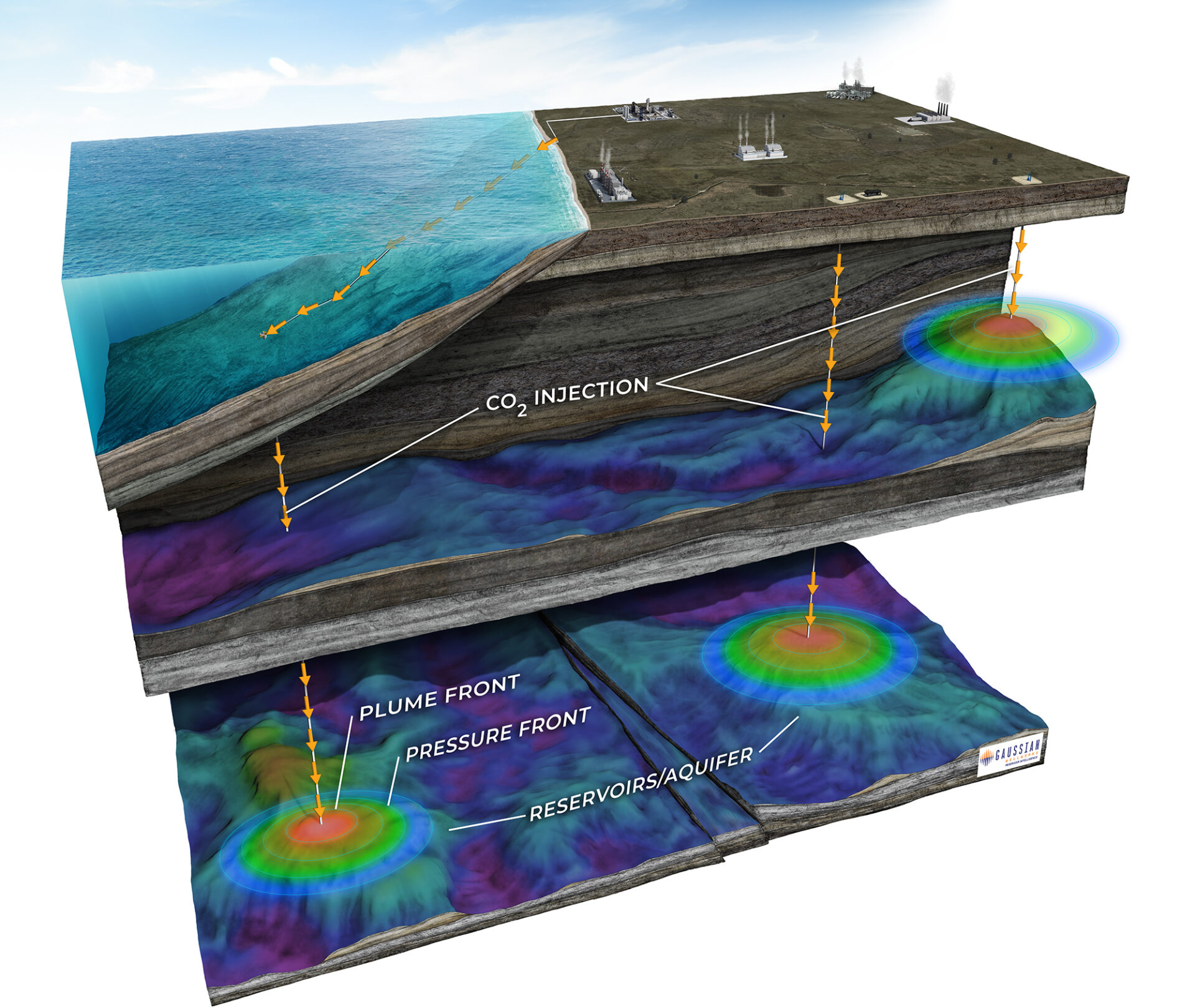
From volumetric optimism to dynamic storage confidence
Gaussian Wellworks uses fast, physics-based GPT modeling to quantify usable CO₂ storage capacity, pressure, plume behavior, and uncertainty within injectivity and containment limits—providing a defensible basis for project screening, appraisal, permitting, and investment decisions.
The core workflow is built around Gaussian Pressure Transient (GPT) solutions of the pressure diffusivity equation. GPT provides a closed-form, non-gridded way to model pressure propagation, well rates and cumulative injections under defined reservoir, fluid, boundary, and operating conditions. It is particularly useful for rapid project screening, legacy-field redevelopment, and probabilistic storage classification because it connects well performance to reservoir properties such as permeability, porosity, compressibility, fluid viscosity, pressure, and boundary conditions.
Where geomechanical effects are material, pressure-dependent rock stiffness can be incorporated to account for changes in bulk modulus, hydraulic diffusivity, and pressure dissipation as injection raises pore pressure. This improves the realism of injection forecasts compared with static assumptions that treat the reservoir as an unchanging container.
Define uncertainties in input data, generate P90/P50/P10 storage ranges, and assess parameter sensitivities to identify high-value data acquisition priorities.
Classify and report
SRMS-aligned documentation, assumptions, decision implications, and development recommendations.
Client Receivables
Operators
TSR, EUS and storage coefficients, with P90/P50/P10 ranges.
Injectivity, cumulative-injection and rate/BHP operating envelopes.
CO₂ plume and pressure-front forecasts, with containment-risk assessment.
Well placement, operating and monitoring recommendations.
Investors & Lenders
Conservative P90, base P50 and upside P10 capacity cases.
Storage-target feasibility under injectivity, pressure and containment constraints.
Key uncertainty, sensitivity and data-quality drivers.
SRMS-aligned technical results for due diligence, financing and investment review.
Regulators & Auditors
SRMS-aligned classification support and probabilistic reporting.
Documented, reproducible methodology and calculation workflow.
Traceable data, assumptions, calibration and uncertainty inputs.
Audit-ready pressure, plume, containment and risk documentation.
Proven Results in the Field
Validation of Carbon Storage Capacity in the Depleted Oil Reservoir, Greensand Project, Nini West, Offshore Denmark
For Nini West, GPT did more than confirm storage potential — it exposed the risk range behind the 4.5 Mt CO₂ target. While the deterministic forecast reached 8.38 Mt and the P50 case reached 7.73 Mt, the P90 case was only 3.25 Mt, showing that the target is technically achievable but vulnerable to injectivity, completion, pressure-management, and data-quality risks.
Read more peer-reviewed studies further demonstrating the reliability and technical validity of Gaussian technology.
Probabilistic CO2 Storage Capacity Appraisal of the Greensand Project in the Depleted Nini Oil Field, Offshore Denmark
Al-Raeeini, K., Budiman, O., Weijermars, R.June 1, 2026Fuel
The Greensand Geological Carbon Storage (GCS) project aims to repurpose multiple depleted oil fields in the North Sea Basin for carbon sequestration, storing up to 8 megatonnes (Mt) of CO2 per year by 2030. It is anticipated that 0.45 mtpa will be stored in the Nini West oil field, offshore Denmark, between 2026 and 2040. This study provides an independent probabilistic appraisal of the storage capacity feasibility of Project Greensand, utilizing publicly available data and following the SPE Storage Resources Management System (SRMS) framework. Arps Decline Curve Analysis (DCA) demonstrated an excellent fit to the historical production rates, with a cumulative error of 0.41 %, confirming its effectiveness. History matching using the Gaussian Pressure Transient (GPT) equation, supported by Sequential Quadratic Programming (SQP) optimization and sensitivity analysis of reservoir parameters, resulted in a highly accurate fit with an error of just 0.0068 %. Having thus constrained reservoir parameters, the Estimated Ultimate Storage (EUS) capacity appears to surpass the 10-year storage target of 4.5, with a deterministic EUS of 8.38 (average 2,296 t/day). The EUS, using SRMS terminology, accounts for just ∼4.71 % of the Total Storage Resource (TSR), indicating vast additional potential for future storage. Subsequent probabilistic analysis reveals that the deterministic estimate closely aligns with the P50 estimate of 7.73 Mt, whereas the P90 estimate of 3.25 is slightly lower than the planned target of 4.5 Mt. Flow scaling ratio investigation shows that lateral flow will dominate during the early injection stages and in wellbore proximity, whereas buoyancy will become increasingly prevalent after three years of injection. Given that public funding supports Project Greensand, full transparency in the reporting of storage capacity and sharing of relevant data are advocated here.The Greensand Geological Carbon Storage (GCS) project aims to repurpose multiple depleted oil fields in the North Sea Basin for carbon sequestration, storing up to 8 megatonnes (Mt) of CO2 per year by 2030. It is anticipated that 0.45 mtpa will be stored in the Nini West oil field, offshore Denmark, between 2026 and 2040. This study provides an independent probabilistic appraisal of the storage capacity feasibility of Project Greensand, utilizing publicly available data and following the SPE Storage Resources Management System (SRMS) framework. Arps Decline Curve Analysis (DCA) demonstrated an excellent fit to the historical production rates, with a cumulative error of 0.41 %, confirming its effectiveness. History matching using the Gaussian Pressure Transient (GPT) equation, supported by Sequential Quadratic Programming (SQP) optimization and sensitivity analysis of reservoir parameters, resulted in a highly accurate fit with an error of just 0.0068 %. Having thus constrained reservoir parameters, the Estimated Ultimate Storage (EUS) capacity appears to surpass the 10-year storage target of 4.5, with a deterministic EUS of 8.38 (average 2,296 t/day). The EUS, using SRMS terminology, accounts for just ∼4.71 % of the Total Storage Resource (TSR), indicating vast additional potential for future storage. Subsequent probabilistic analysis reveals that the deterministic estimate closely aligns with the P50 estimate of 7.73 Mt, whereas the P90 estimate of 3.25 is slightly lower than the planned target of 4.5 Mt. Flow scaling ratio investigation shows that lateral flow will dominate during the early injection stages and in wellbore proximity, whereas buoyancy will become increasingly prevalent after three years of injection. Given that public funding supports Project Greensand, full transparency in the reporting of storage capacity and sharing of relevant data are advocated here.
Elastic Stiffening of Reservoir Rocks with Rising Pore Pressures under Constant Biaxial Far-Field Stress: Application to the Porthos Geological Carbon-Dioxide Sequestration Project
Toko, A.D.P., and Weijermars, R.February 26, 2026Geomechanics and Geophysics for Geo-Energy and Geo-Resources
This study systematically quantifies elastic stiffening in fluid-saturated porous media, distinguishing the critical influence of biaxial far-field stress from simplified uniaxial conditions. The Linear Superposition Method (LSM) of elastic displacements is used to quantify solutions of the detailed stress state within a pressure-saturated poro-elastic framework, consisting of regularly arranged cylindrical pores under uniaxial and bi-axial loads. The model examines the impact on the effective bulk modulus of changes in internal pressure, while varying the relative magnitude of the horizontal and vertical stresses ( $$sigma_{yy}$$ = $$lambda sigma_{xx}$$ ). A sensitivity analysis reveals that lateral confinement under biaxial loading significantly accelerates the stiffening process. Specifically, the effective bulk modulus reaches a porosity-independent state when the internal pore pressure balances the far-field confining stress, a condition reached at a significantly lower pressure-to-stress ratio than observed under uniaxial loading. To demonstrate practical implications, the model is applied to the Porthos Geological Carbon Sequestration (GCS) project in a depleted offshore gas field (Netherlands). The results indicate that injection-induced pore pressure increases lead to a non-linear increase in the reservoir’s bulk modulus, which in turn increases hydraulic diffusivity. This suggests that depleted gas reservoirs may accommodate slightly higher injection rates than predicted if the faster pressure dissipation associated with elastic stiffening is neglected.This study systematically quantifies elastic stiffening in fluid-saturated porous media, distinguishing the critical influence of biaxial far-field stress from simplified uniaxial conditions. The Linear Superposition Method (LSM) of elastic displacements is used to quantify solutions of the detailed stress state within a pressure-saturated poro-elastic framework, consisting of regularly arranged cylindrical pores under uniaxial and bi-axial loads. The model examines the impact on the effective bulk modulus of changes in internal pressure, while varying the relative magnitude of the horizontal and vertical stresses ( $$sigma_{yy}$$ = $$lambda sigma_{xx}$$ ). A sensitivity analysis reveals that lateral confinement under biaxial loading significantly accelerates the stiffening process. Specifically, the effective bulk modulus reaches a porosity-independent state when the internal pore pressure balances the far-field confining stress, a condition reached at a significantly lower pressure-to-stress ratio than observed under uniaxial loading. To demonstrate practical implications, the model is applied to the Porthos Geological Carbon Sequestration (GCS) project in a depleted offshore gas field (Netherlands). The results indicate that injection-induced pore pressure increases lead to a non-linear increase in the reservoir’s bulk modulus, which in turn increases hydraulic diffusivity. This suggests that depleted gas reservoirs may accommodate slightly higher injection rates than predicted if the faster pressure dissipation associated with elastic stiffening is neglected.
Concurrent approaches for estimating storage coefficients (E) of Geological Carbon Sequestration (GCS) target reservoirs are critically reviewed, and a robust procedure for estimation of such coefficients, which are time-dependent, is proposed. Our method is based on close analogy of what historically is done in hydrocarbon production and reserves estimations using recovery factors (F). Typically, F is computed by first estimating the original hydrocarbons in place (OHIP), then the cumulative production to a certain date (of the economic limit) is computed using production forecasting methods. The production forecast provides an estimated ultimate resource (EUR), and then F follows from the ratio EUR/OHIP. We propose to similarly compute the estimated ultimate storage (EUS) or cumulative injection by forward modeling, using Gaussian-based solutions of the pressure diffusivity equation, and after estimating the total storage resource (TSR), the coefficient E follows from the ratio EUS/TSR. The new method is demonstrated in a case study using representative data from the Porthos GCS Project, which repurposes the depleted P18 gas field (offshore, Dutch shelf area) for geological CO2 sequestration (GCS). The storage coefficient for the P18-6 segment of the Porthos GCS field after 20 years of injection reaches 18 %. In addition to the deterministic storage coefficient estimation, probabilistic values after 20 years of injection for E were estimated: P90-16 %, P50-36 % and P10-59 %. Separately, it is shown how a GCS project in a depleted gas field offers significant operational advantages over storage in saline aquifers. The competitive edge of depleted gas fields over saline aquifers has not been articulated before. The new methods for computing TSR, EUS and E, can handle probabilistic storage resource classification in compliance with the SPE SRMS classification framework for storage resource estimation.Concurrent approaches for estimating storage coefficients (E) of Geological Carbon Sequestration (GCS) target reservoirs are critically reviewed, and a robust procedure for estimation of such coefficients, which are time-dependent, is proposed. Our method is based on close analogy of what historically is done in hydrocarbon production and reserves estimations using recovery factors (F). Typically, F is computed by first estimating the original hydrocarbons in place (OHIP), then the cumulative production to a certain date (of the economic limit) is computed using production forecasting methods. The production forecast provides an estimated ultimate resource (EUR), and then F follows from the ratio EUR/OHIP. We propose to similarly compute the estimated ultimate storage (EUS) or cumulative injection by forward modeling, using Gaussian-based solutions of the pressure diffusivity equation, and after estimating the total storage resource (TSR), the coefficient E follows from the ratio EUS/TSR. The new method is demonstrated in a case study using representative data from the Porthos GCS Project, which repurposes the depleted P18 gas field (offshore, Dutch shelf area) for geological CO2 sequestration (GCS). The storage coefficient for the P18-6 segment of the Porthos GCS field after 20 years of injection reaches 18 %. In addition to the deterministic storage coefficient estimation, probabilistic values after 20 years of injection for E were estimated: P90-16 %, P50-36 % and P10-59 %. Separately, it is shown how a GCS project in a depleted gas field offers significant operational advantages over storage in saline aquifers. The competitive edge of depleted gas fields over saline aquifers has not been articulated before. The new methods for computing TSR, EUS and E, can handle probabilistic storage resource classification in compliance with the SPE SRMS classification framework for storage resource estimation.
Benchmarking physics-based GPT and empirical Arps DCA for EUR and CO2 storage capacity assessment of depleted gas reservoirs
Afagwu, C. and Weijermars, R.December 1, 2025Fuel
Accurate well performance forecasting is crucial for optimizing hydrocarbon recovery and also for repurposing depleted reservoirs for CO2 storage. This study compares the physics-based Gaussian Pressure Transient (GPT) method with the empirical Arps Decline Curve Analysis (DCA) method for history matching and predicting production/injection behavior of legacy gas wells in the UK North Sea. Using bootstrapping of historical production-rate data from the Kelvin, Mimas, and Tethys Fields, we evaluate each method’s effectiveness in capturing reservoir performance over the full well-life. Our findings show that both methods can accurately history-match historical production data. However, GPT outperforms the Arps method in predicting production from bootstrapped, short-term production data, demonstrating better resilience to noisy data and more accurate estimation of the ultimate recovery (EUR). Subsequently, CO2 injectivity and storage capacity were evaluated for abandoned wells in lease Blocks 43 and 48. The Kelvin Field well (Block 43) showed the highest injectivity at 10.96 Mscf/day/psi, more than three times that of the Mimas and Tethys wells (2.04–3.00 Mscf/day/psi) in Block 48. The three wells collectively offer a storage capacity of 16.91 Bscf (∼1 Mt) over a certain injection-period duration. Wells in Block 48, have potential for continued CO2 injection, suggesting opportunities for long-term storage optimization.Accurate well performance forecasting is crucial for optimizing hydrocarbon recovery and also for repurposing depleted reservoirs for CO2 storage. This study compares the physics-based Gaussian Pressure Transient (GPT) method with the empirical Arps Decline Curve Analysis (DCA) method for history matching and predicting production/injection behavior of legacy gas wells in the UK North Sea. Using bootstrapping of historical production-rate data from the Kelvin, Mimas, and Tethys Fields, we evaluate each method’s effectiveness in capturing reservoir performance over the full well-life. Our findings show that both methods can accurately history-match historical production data. However, GPT outperforms the Arps method in predicting production from bootstrapped, short-term production data, demonstrating better resilience to noisy data and more accurate estimation of the ultimate recovery (EUR). Subsequently, CO2 injectivity and storage capacity were evaluated for abandoned wells in lease Blocks 43 and 48. The Kelvin Field well (Block 43) showed the highest injectivity at 10.96 Mscf/day/psi, more than three times that of the Mimas and Tethys wells (2.04–3.00 Mscf/day/psi) in Block 48. The three wells collectively offer a storage capacity of 16.91 Bscf (∼1 Mt) over a certain injection-period duration. Wells in Block 48, have potential for continued CO2 injection, suggesting opportunities for long-term storage optimization.
CO2 Storage capacity classification and compliance
Weijermars, R.November 1, 2024First Break
The Society of Petroleum Engineers (SPE) has proposed a framework for the classification of CO2 storage resources and storage capacity, known as the Storage Resources Management System (SRMS, 2017). The SRMS framework aims to provide guidelines for the classification and reporting of CO2 assets. It’s similar to SPE’s well-established framework for hydrocarbon resources and reserves classification, known as the Petroleum Resource Management System (PRMS, 2018). Meanwhile, revisions of both the 2018 version of PRMS and 2017 version of SRMS are underway, with public consultations of practitioners completed in 2024 (PRMS, 2024; SRMS, 2024).
While the PRMS is actually used industry-wide, this cannot be said for the SRMS. There is a nascent CO2 storage business segment, with mushrooming carbon removal startups. This fledgling new industry is now proposing a carbon removal quality assurance Code of Practice, at the same time as SPE is spending efforts on revising its carbon resources management system. The absence of track record and weak incentives, as well as a lack of case studies on how to apply SRMS in practice, are lurking in the background. Additionally, the groundswell of arguably opportunistic providers of storage capacity has created an unprecedented situation where carbon removal companies offer mostly unclassified storage capacity (in SRMS classification’s sense), as will be detailed below. The lack of validated storage capacity is an important hurdle in startup credibility — investors should be wary.The Society of Petroleum Engineers (SPE) has proposed a framework for the classification of CO2 storage resources and storage capacity, known as the Storage Resources Management System (SRMS, 2017). The SRMS framework aims to provide guidelines for the classification and reporting of CO2 assets. It’s similar to SPE’s well-established framework for hydrocarbon resources and reserves classification, known as the Petroleum Resource Management System (PRMS, 2018). Meanwhile, revisions of both the 2018 version of PRMS and 2017 version of SRMS are underway, with public consultations of practitioners completed in 2024 (PRMS, 2024; SRMS, 2024).
While the PRMS is actually used industry-wide, this cannot be said for the SRMS. There is a nascent CO2 storage business segment, with mushrooming carbon removal startups. This fledgling new industry is now proposing a carbon removal quality assurance Code of Practice, at the same time as SPE is spending efforts on revising its carbon resources management system. The absence of track record and weak incentives, as well as a lack of case studies on how to apply SRMS in practice, are lurking in the background. Additionally, the groundswell of arguably opportunistic providers of storage capacity has created an unprecedented situation where carbon removal companies offer mostly unclassified storage capacity (in SRMS classification’s sense), as will be detailed below. The lack of validated storage capacity is an important hurdle in startup credibility — investors should be wary.
Deferring Flood Damage in Coastal Lowlands: Assessing Surface Uplift by Geo-Engineered CO2-Sequestration with Easy-to-Use Land-Uplift Model
Weijermars, R.April 1, 2024First Break
Mitigating flood risk of heavily urbanised coastal regions by geo-engineered surface uplift via CO2-sequestration may help to create commercially viable storage opportunities for greenhouse gases like CO2. Recent projections for increased global flood risk due to sea level rise induced by rising CO2-emissions are briefly reviewed. Next, a practical geo-mechanical model is presented, suitable for quick technical assessments of the key physical parameters that contribute most to achieving a specific surface uplift rate required to outpace the projected relative sea level rise for a certain region at risk. The model allows for probabilistic inputs to (1) capture the uncertainty in the value of key input parameters, and (2) link and rank the sensitivity of the surface uplift, to the individual input parameters (in tornado and spider graphs). Three uplift scenarios are given to demonstrate the feasibility of flood mitigation with CO2-sequestration. Finally, a discussion places the emergence of CO2-injection projects in a historic perspective, and highlights the critical key factors in the future screening of any CO2-injection prospects. These factors include the evaluation of technical challenges, potential risks, stakeholder management, public education and perception management.Mitigating flood risk of heavily urbanised coastal regions by geo-engineered surface uplift via CO2-sequestration may help to create commercially viable storage opportunities for greenhouse gases like CO2. Recent projections for increased global flood risk due to sea level rise induced by rising CO2-emissions are briefly reviewed. Next, a practical geo-mechanical model is presented, suitable for quick technical assessments of the key physical parameters that contribute most to achieving a specific surface uplift rate required to outpace the projected relative sea level rise for a certain region at risk. The model allows for probabilistic inputs to (1) capture the uncertainty in the value of key input parameters, and (2) link and rank the sensitivity of the surface uplift, to the individual input parameters (in tornado and spider graphs). Three uplift scenarios are given to demonstrate the feasibility of flood mitigation with CO2-sequestration. Finally, a discussion places the emergence of CO2-injection projects in a historic perspective, and highlights the critical key factors in the future screening of any CO2-injection prospects. These factors include the evaluation of technical challenges, potential risks, stakeholder management, public education and perception management.
Sensitivity Analysis of CO2-Migration Paths in Geological Carbon-Dioxide Sequestration: Case Study of the Gorgon GCS Project
Afagwu, C. and Weijermars, R.January 1, 2024SSRN
Tracking the flow path of injected fluid in geological carbon-dioxide sequestration (GCS) studies is important for flow conformance control. A Gaussian Pressure Transient method is applied in a sensitivity study of the world’s largest GCS-project associated with the Gorgon-Io natural gas extraction project, Australia. The Gorgon GCS project aims to inject around 120 million tons (2 Tscf) CO2 produced from the LNG processing plant into a deep saline aquifer (Dupuy Formation) over the 40+ years project life. The CO2 injection started in August 2019, and is currently operating at one-third of planned capacity, due to well-control and pressure-management issues. The recently developed Gaussian simulation method was employed to independently assess and show under which conditions the CO2 migration path will be conformant to safe sequestration in the target zone by the avoidance of pressure escalation. The study outcome demonstrates that if rock wettability shifts from water-wet to weakly water-wet during the course of a GCS project, this could cause a shift in critical CO2 saturation, which impacts both the flow paths and migration rates of the injected CO2. Furthermore, increasing water withdrawal rates from the production wells and strategically adjusting CO2 injection pressure can further reduce the risk of premature CO2 break-through. The modeling approach used in this study, provides valuable insights for optimizing the number and spacing of injectors and producers, as well as for adjustment of water-withdrawal rates, and injection pressures, in response to possible changes in rock wettability during CO2 flooding in aquifers with pressure relief wells, similar to the Gorgon GCS Project. The reservoir pressure, fluid migration rates and flow paths can be quantified with unlimited resolution, because the GPT-solution method is closed-form based.Tracking the flow path of injected fluid in geological carbon-dioxide sequestration (GCS) studies is important for flow conformance control. A Gaussian Pressure Transient method is applied in a sensitivity study of the world’s largest GCS-project associated with the Gorgon-Io natural gas extraction project, Australia. The Gorgon GCS project aims to inject around 120 million tons (2 Tscf) CO2 produced from the LNG processing plant into a deep saline aquifer (Dupuy Formation) over the 40+ years project life. The CO2 injection started in August 2019, and is currently operating at one-third of planned capacity, due to well-control and pressure-management issues. The recently developed Gaussian simulation method was employed to independently assess and show under which conditions the CO2 migration path will be conformant to safe sequestration in the target zone by the avoidance of pressure escalation. The study outcome demonstrates that if rock wettability shifts from water-wet to weakly water-wet during the course of a GCS project, this could cause a shift in critical CO2 saturation, which impacts both the flow paths and migration rates of the injected CO2. Furthermore, increasing water withdrawal rates from the production wells and strategically adjusting CO2 injection pressure can further reduce the risk of premature CO2 break-through. The modeling approach used in this study, provides valuable insights for optimizing the number and spacing of injectors and producers, as well as for adjustment of water-withdrawal rates, and injection pressures, in response to possible changes in rock wettability during CO2 flooding in aquifers with pressure relief wells, similar to the Gorgon GCS Project. The reservoir pressure, fluid migration rates and flow paths can be quantified with unlimited resolution, because the GPT-solution method is closed-form based.
Surface subsidence and uplift resulting from well interventions modeled with coupled analytical solutions: Application to Groningen gas extraction (Netherlands) and CO2-EOR in the Kelly-Snyder oil field (West Texas)
Weijermars, R.September 1, 2023Geoenergy Science and Engineering
This study presents a novel analytical model for history-matching the observed subsidence and/or uplift due to, respectively, fluid extraction from – or injection into – the pore space of subsurface reservoirs. Development of the model was prompted by the need to have a fast evaluation tool to support the various exploitation modes of subsurface reservoirs, either in fluid extraction projects (hydrocarbons, aquifers, geothermal fields) or in fluid storage projects (waste water, natural gas, hydrogen, and CO2-sequestration). The model proposed here is a novel analytical solution method obtained by coupling the vertical strain changes in a reservoir due to changes in reservoir pressure with a buckling plate model for the overburden. After a brief review of state-of-the-art (numerical and analytical tools), the coupled reservoir pressure change and overburden buckling model (in brief: pressure change-buckling model) is presented. Subsequently, the coupled pressure change-buckling model is applied in two case studies. The first case study history-matches the subsidence of the Groningen Field (Netherlands) over the period 1963–2020, due to the pressure depletion caused by natural gas extraction. The second case study applies the model to history-match the uplift history above an oil field in Scurry County (West Texas) over the period 2007–2011, due to net fluid injection related to enhanced oil recovery (EOR) activities. Separately, in addition to history-matching applications the coupled pressure change-buckling model can also be applied in forward modeling mode to predict the surface response of future operations involving pressure changes in subsurface reservoirs.This study presents a novel analytical model for history-matching the observed subsidence and/or uplift due to, respectively, fluid extraction from – or injection into – the pore space of subsurface reservoirs. Development of the model was prompted by the need to have a fast evaluation tool to support the various exploitation modes of subsurface reservoirs, either in fluid extraction projects (hydrocarbons, aquifers, geothermal fields) or in fluid storage projects (waste water, natural gas, hydrogen, and CO2-sequestration). The model proposed here is a novel analytical solution method obtained by coupling the vertical strain changes in a reservoir due to changes in reservoir pressure with a buckling plate model for the overburden. After a brief review of state-of-the-art (numerical and analytical tools), the coupled reservoir pressure change and overburden buckling model (in brief: pressure change-buckling model) is presented. Subsequently, the coupled pressure change-buckling model is applied in two case studies. The first case study history-matches the subsidence of the Groningen Field (Netherlands) over the period 1963–2020, due to the pressure depletion caused by natural gas extraction. The second case study applies the model to history-match the uplift history above an oil field in Scurry County (West Texas) over the period 2007–2011, due to net fluid injection related to enhanced oil recovery (EOR) activities. Separately, in addition to history-matching applications the coupled pressure change-buckling model can also be applied in forward modeling mode to predict the surface response of future operations involving pressure changes in subsurface reservoirs.
Stream and Potential Functions for Transient Flow Simulations in Porous Media with Pressure-Controlled Well Systems
Alotaibi, M.; Alotaibi, S.; Weijermars, R.May 17, 2023
Gaussian solutions of the diffusion equation can be applied to visualize the flow paths in subsurface reservoirs due to the spatial advance of the pressure gradient caused by engineering interventions (vertical wells, horizontal wells) in subsurface reservoirs for the extraction of natural resources (e.g., water, oil, gas, and geothermal fluids). Having solved the temporal and spatial changes in the pressure field caused by the lowered pressure of a well’s production system, the Gaussian method is extended and applied to compute and visualize velocity magnitude contours, streamlines, and other relevant flow attributes in the vicinity of well systems that are depleting the pressure in a reservoir. We derive stream function and potential function solutions that allow instantaneous modeling of flow paths and pressure contour solutions for transient flows. Such analytical solutions for transient flows have not been derived before without time-stepping. The new closed-form solutions avoid the computational complexity of time-stepping, required when time-dependent flows are modeled by superposing steady-state solutions using complex analysis methods.Gaussian solutions of the diffusion equation can be applied to visualize the flow paths in subsurface reservoirs due to the spatial advance of the pressure gradient caused by engineering interventions (vertical wells, horizontal wells) in subsurface reservoirs for the extraction of natural resources (e.g., water, oil, gas, and geothermal fluids). Having solved the temporal and spatial changes in the pressure field caused by the lowered pressure of a well’s production system, the Gaussian method is extended and applied to compute and visualize velocity magnitude contours, streamlines, and other relevant flow attributes in the vicinity of well systems that are depleting the pressure in a reservoir. We derive stream function and potential function solutions that allow instantaneous modeling of flow paths and pressure contour solutions for transient flows. Such analytical solutions for transient flows have not been derived before without time-stepping. The new closed-form solutions avoid the computational complexity of time-stepping, required when time-dependent flows are modeled by superposing steady-state solutions using complex analysis methods.