Shale well performance optimization using Gaussian to improve production, history matching, and fracture design decisions
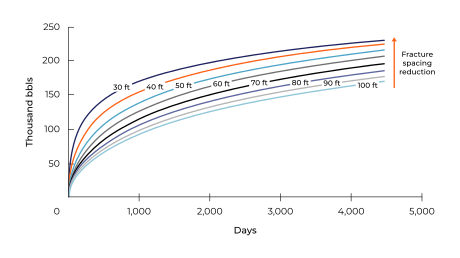
Optimizing fracture spacing increased projected production from about 150,000 to 220,000 barrels over 8 years.
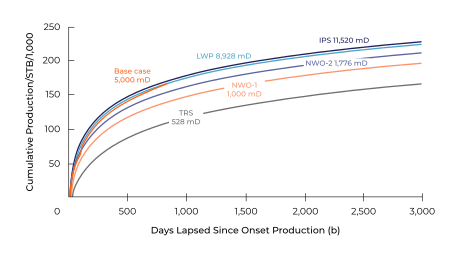
Choosing a more conductive fracture-support material increased projected production from roughly 170,000 to 230,000 barrels.
Gaussian produced these insights quickly, helping operators make better completion and capital decisions without lengthy numerical simulations.
Summary
This case study shows that shale-well performance depends not only on fracture spacing and fracture half-length, but also on whether the proppant pack preserves conductivity after pumping. Gaussian makes these trade-offs visible quickly in production terms, without relying on time-intensive numerical simulation workflows.
Objective
To show how Gaussian can rapidly quantify the production impact of three key completion variables: fracture spacing / half-length, proppant-pack conductivity, and proppant pump schedule.
Gaussian Solution
Gaussian is used as the fast physics-based production forecasting framework for comparing completion scenarios. In this study, it quantifies how cumulative production changes when fracture spacing changes (Figure 1) and when proppant-pack permeability changes (Figure 2). The same framework also links pressure loss in the fracture system to real production loss, which is why it is especially useful for diagnosing fracture conductivity damage.
Results and Findings
Figure 1 highlights Gaussian’s ability to quantify the impact of fracture spacing on EUR. After 3,000 days, optimal production is approximately 220,000 bbl at 30 ft spacing, declining to about 150,000 bbl at 100 ft spacing. This clearly shows how fracture spacing—and the related effective fracture half-length design—can materially influence well performance.
Figure 1 – Gaussian rapidly quantifies the EUR impact of fracture-spacing
Figure 2 demonstrates that proppant-pack conductivity is equally important. Over the same 3,000-day period, cumulative production rises from about 170,000 bbl with Texas Regional Sand (TRS) to approximately 230,000 bbl with Intermediate Strength Ceramic proppants (ISP), a gain of roughly 26%.
Figure 2 – EUR sensitivity to proppant-pack permeability
Across multiple wells, including those in the Eagle Ford and Wolfcamp formations of Texas, Gaussian generated insights from historical data that were previously achievable only through numerical simulation. These analyses can now be completed quickly through a closed-form workflow, significantly accelerating evaluation.
Peer-reviewed studies further demonstrating the reliability and technical validity of Gaussian technology.
Computation of pressure depletion and productivity of multi-fractured wells with variable fracture spacing using fast and accurate solution method
Tian, Y. and Weijermars, R.March 1, 2026Petroleum Research
This study presents a fast method that can model the pressure depletion around hydraulically fractured wells accurately. The Gaussian Pressure-Transient (GPT) method has infinite resolution, because no discrete-grid computations are required − the method solves the pressure field using closed-form solutions. After extensive testing on field cases and calibration against other (independent) solution-methods, it appeared that the pressure interference of multiple fractures represented by pressure transients − in the early phases of pressure advance − behaves according to the traditional superposition-method. However, when pressure interference advances, the traditional superposition method gives increasingly unrealistic and inaccurate results. Therefore, the traditional superposition method typically used for steady-state, needs adjustment when applied to transient systems, modeled here with Gaussian pressure-diffusion probability-density functions. The new solutions are valid for the advance of pressure changes both in the early and late stages of the well-life. A second new insight presented here is that the superposition of multiple fractures using Gaussian solutions (together with pressure-gradient computations and application of Darcy’s) can accurately forecast the future production rate and cumulative production of the well over the economic well-life, accounting for the impact of fracture-spacing changes. The new method is validated by history-matching of our Gaussian forecasts using real well-data to constrain specific reservoir properties (hydraulic diffusivity) and completion parameters (fracture half-lengths), and then was benchmarked against independent simulations with CMG-IMEX.This study presents a fast method that can model the pressure depletion around hydraulically fractured wells accurately. The Gaussian Pressure-Transient (GPT) method has infinite resolution, because no discrete-grid computations are required − the method solves the pressure field using closed-form solutions. After extensive testing on field cases and calibration against other (independent) solution-methods, it appeared that the pressure interference of multiple fractures represented by pressure transients − in the early phases of pressure advance − behaves according to the traditional superposition-method. However, when pressure interference advances, the traditional superposition method gives increasingly unrealistic and inaccurate results. Therefore, the traditional superposition method typically used for steady-state, needs adjustment when applied to transient systems, modeled here with Gaussian pressure-diffusion probability-density functions. The new solutions are valid for the advance of pressure changes both in the early and late stages of the well-life. A second new insight presented here is that the superposition of multiple fractures using Gaussian solutions (together with pressure-gradient computations and application of Darcy’s) can accurately forecast the future production rate and cumulative production of the well over the economic well-life, accounting for the impact of fracture-spacing changes. The new method is validated by history-matching of our Gaussian forecasts using real well-data to constrain specific reservoir properties (hydraulic diffusivity) and completion parameters (fracture half-lengths), and then was benchmarked against independent simulations with CMG-IMEX.
Production Optimization in Shale Formations: Focus on Proppant Delivery Schedules and Mitigation of Fracture Conductivity Damage
Weijermars, R.February 1, 2026
This study presents recent advances in modeling capacity and provides optimization guidelines for key operational parameters controlling well performance, using real well data. A new Gaussian solution method can both accurately forecast well rates prior to drilling and history match actual well performance after completion once early production data become available. Unlike other history-matching tools, excellent matches are achieved with daily production data spanning just a few months. The study also addresses key challenges in achieving precision in hydraulic fracturing and horizontal well design, emphasizing unresolved subsurface heterogeneity, variability in treatment quality, and modeling tool limitations. Advanced analytical methods, such as the Gaussian Production Forecasting (GPT) method, offer improved accuracy and computational efficiency for production predictions. Empirical data from the Eagle Ford and Wolfcamp formations demonstrate significant performance gains over the past decade, driven by optimized fracture spacing, increased lateral lengths, and enhanced proppant usage. However, performance gaps persist due to poor proppant conductivity, closure stress impacts, and proppant transport inefficiencies. This study highlights the critical impact of fracture conductivity damage on shale well performance, as revealed by Gaussian well performance curves derived from historical data. The findings emphasize the need for integrating advanced modeling tools, optimizing proppant delivery strategies, and improving transport simulations to achieve sustained productivity gains in shale reservoirs.This study presents recent advances in modeling capacity and provides optimization guidelines for key operational parameters controlling well performance, using real well data. A new Gaussian solution method can both accurately forecast well rates prior to drilling and history match actual well performance after completion once early production data become available. Unlike other history-matching tools, excellent matches are achieved with daily production data spanning just a few months. The study also addresses key challenges in achieving precision in hydraulic fracturing and horizontal well design, emphasizing unresolved subsurface heterogeneity, variability in treatment quality, and modeling tool limitations. Advanced analytical methods, such as the Gaussian Production Forecasting (GPT) method, offer improved accuracy and computational efficiency for production predictions. Empirical data from the Eagle Ford and Wolfcamp formations demonstrate significant performance gains over the past decade, driven by optimized fracture spacing, increased lateral lengths, and enhanced proppant usage. However, performance gaps persist due to poor proppant conductivity, closure stress impacts, and proppant transport inefficiencies. This study highlights the critical impact of fracture conductivity damage on shale well performance, as revealed by Gaussian well performance curves derived from historical data. The findings emphasize the need for integrating advanced modeling tools, optimizing proppant delivery strategies, and improving transport simulations to achieve sustained productivity gains in shale reservoirs.
Fast Production and Water-Breakthrough Analysis Methods Demonstrated Using Volve Field Data
Weijermars, R.September 1, 2024Petroleum Research
When producing from conventional fields, the well rates are primarily constrained by the production-system in the early years of the field-life, while later in the field-life the production rates are primarily constrained by the reservoir deliverability. For the post-plateau production period, the reservoir deliverability will no longer potentially exceed the production-system well-rate constraints. Traditionally, analytical equations are used in a nodal analysis method that balances the pressure at the well inflow point from the reservoir (inflow performance relationship; IPR) with the pressure required for the vertical lift performance (VLP; or vertical flow performance; VFP) from the same point upward. A faster and simpler approach is proposed in the present study. Whereas, the classical IPR solutions are based on a constant well-rate solution of the diffusivity equation, use of a constant bottomhole pressure assumption can bypass the need for nodal analysis type pressure matching solutions to obtain the well rate. Instead, the well rate can be directly computed from the pressure decline in the reservoir and any production system capacity constraint can be imposed on the theoretical well rate due to the reservoir quality. The merits of the new approach are explained and illustrated by way of a detailed production analysis case study using open-access data from the Volve Field (Norwegian Continental Shelf). In addition, the case study of the Volve Field wells demonstrates a new water-breakthrough analysis method.When producing from conventional fields, the well rates are primarily constrained by the production-system in the early years of the field-life, while later in the field-life the production rates are primarily constrained by the reservoir deliverability. For the post-plateau production period, the reservoir deliverability will no longer potentially exceed the production-system well-rate constraints. Traditionally, analytical equations are used in a nodal analysis method that balances the pressure at the well inflow point from the reservoir (inflow performance relationship; IPR) with the pressure required for the vertical lift performance (VLP; or vertical flow performance; VFP) from the same point upward. A faster and simpler approach is proposed in the present study. Whereas, the classical IPR solutions are based on a constant well-rate solution of the diffusivity equation, use of a constant bottomhole pressure assumption can bypass the need for nodal analysis type pressure matching solutions to obtain the well rate. Instead, the well rate can be directly computed from the pressure decline in the reservoir and any production system capacity constraint can be imposed on the theoretical well rate due to the reservoir quality. The merits of the new approach are explained and illustrated by way of a detailed production analysis case study using open-access data from the Volve Field (Norwegian Continental Shelf). In addition, the case study of the Volve Field wells demonstrates a new water-breakthrough analysis method.
Gaussian Pressure-Transients: A Toolkit for Production Forecasts and Optimization of Multi-Fractured Well Systems in Shale Formations
Afagwu, C., Al-Afnan, S., Abdalla, M. and Weijermars, R.April 3, 2024Arabian Journal of Science and Engineering
High development cost of shale fields produced with multi-fractured well systems prompts for improved and faster production forecasting tools. This study advances the use of a Gaussian pressure transient-based reservoir model (GRM). In this new simulator, the migration of reservoir fluids is fully controlled by the hydraulic diffusivity; the value of which can be initially estimated for any particular reservoir by history-matching a Gaussian decline curve to early production data. In a next step, the reservoir model based on the Gaussian pressure transient will compute—from the bottomhole pressures in the well system (imposed by the engineering intervention on the initial reservoir pressure)—the spatial and temporal advance of the pressure depletion and fluid flow near the multistage fractured wells. Real-world data from the Hydraulic Fracture Test Site-1, Midland Basin (West Texas), is utilized to validate the Gaussian solutions in comparison with a commercial simulator through history-matching and a comprehensive sensitivity analysis. The validated GPT method allows for fast iteration of well productivity sensitivity to the placement and orientation of the hydraulic fractures, allowing for proper planning to optimize field development plans.High development cost of shale fields produced with multi-fractured well systems prompts for improved and faster production forecasting tools. This study advances the use of a Gaussian pressure transient-based reservoir model (GRM). In this new simulator, the migration of reservoir fluids is fully controlled by the hydraulic diffusivity; the value of which can be initially estimated for any particular reservoir by history-matching a Gaussian decline curve to early production data. In a next step, the reservoir model based on the Gaussian pressure transient will compute—from the bottomhole pressures in the well system (imposed by the engineering intervention on the initial reservoir pressure)—the spatial and temporal advance of the pressure depletion and fluid flow near the multistage fractured wells. Real-world data from the Hydraulic Fracture Test Site-1, Midland Basin (West Texas), is utilized to validate the Gaussian solutions in comparison with a commercial simulator through history-matching and a comprehensive sensitivity analysis. The validated GPT method allows for fast iteration of well productivity sensitivity to the placement and orientation of the hydraulic fractures, allowing for proper planning to optimize field development plans.
Probabilistic Production Forecasting and Reserves Estimation: Benchmarking Gaussian Decline Curve Analysis Against the Traditional Arps Method (Wolfcamp Shale Case Study)
Pratama, M.A. Al Qoroni, O., Rahmatullah, I.K., Jameel, M.F., and Weijermars, R.January 1, 2024Geoenergy Science and Engineering
This study provides novel insights into how a relatively new, Gaussian DCA method may be used to forecast well rates and estimate resource volumes produced from unconventional reservoirs. Production data of two wells in the Wolfcamp Shale Formation (Midland Basin, West Texas) were history-matched using both the Arps and Gaussian DCA method. Production forecasts were constructed based on the history-matching of historical production data, and the estimated ultimate recovery (EUR) was determined from the cumulative production at the end of the economic well-life (assumed here to be 40 years). Comparing the results of the conventional Arps and new Gaussian DCA method, we found the Gaussian DCA technique compared favorably to the conventional Arps method, the former being faster and having less error in the history-matching process. The traditional Arps history-matching technique is always initiated with very high initial well rates. In contrast, the very first spike in the actual production rates can be accurately captured by the Gaussian DCA method. The hydraulic diffusivity parameter that was obtained from the history-matching in the Gaussian DCA method was also compared with a calculated diffusivity using primary values obtained from laboratory and well log data. The hydraulic diffusivity parameter obtained from the Gaussian history-match of field data is at the lower side of the probabilistic values calculated based on the laboratory and well log data. A probabilistic regression analysis was applied and the estimated values’ distribution was then adjusted to match the values from the history matches as a basis for the final probabilistic EUR estimations for the study wells. Separately, a bootstrapping method can be used to produce probabilistic EUR estimates based on single well data.This study provides novel insights into how a relatively new, Gaussian DCA method may be used to forecast well rates and estimate resource volumes produced from unconventional reservoirs. Production data of two wells in the Wolfcamp Shale Formation (Midland Basin, West Texas) were history-matched using both the Arps and Gaussian DCA method. Production forecasts were constructed based on the history-matching of historical production data, and the estimated ultimate recovery (EUR) was determined from the cumulative production at the end of the economic well-life (assumed here to be 40 years). Comparing the results of the conventional Arps and new Gaussian DCA method, we found the Gaussian DCA technique compared favorably to the conventional Arps method, the former being faster and having less error in the history-matching process. The traditional Arps history-matching technique is always initiated with very high initial well rates. In contrast, the very first spike in the actual production rates can be accurately captured by the Gaussian DCA method. The hydraulic diffusivity parameter that was obtained from the history-matching in the Gaussian DCA method was also compared with a calculated diffusivity using primary values obtained from laboratory and well log data. The hydraulic diffusivity parameter obtained from the Gaussian history-match of field data is at the lower side of the probabilistic values calculated based on the laboratory and well log data. A probabilistic regression analysis was applied and the estimated values’ distribution was then adjusted to match the values from the history matches as a basis for the final probabilistic EUR estimations for the study wells. Separately, a bootstrapping method can be used to produce probabilistic EUR estimates based on single well data.
Production Forecasting of Unruly Geoenergy Extraction Wells Using Gaussian Decline Curve Analysis
Weijermars, R.September 28, 2023Geofluids
Fast and rigorous well performance evaluation is made possible by new solutions of the pressure diffusion equation. The derived Gaussian pressure transient (GPT) solutions can be practically formulated as a decline curve analysis (DCA) equation for history matching of historic well rates to then forecast the future well performance and estimate the remaining reserves. Application in rate transient analysis (RTA) mode is also possible to estimate fracture half-lengths. Because GPT solutions are physics-based, these can be used for production forecasting as well as in reservoir simulation mode (by computing the spatial and temporal pressure gradients everywhere in the reservoir section drained by either an existing or a planned well). The present paper focuses on the physics-based production forecasting of so-called “unruly” wells, which at first seem to have production behavior noncompliant with any DCA curve. Four shale wells (one from the Utica, Ohio; one from the Eagle Ford Formation, East Texas; and two from the Wolfcamp Formation, West Texas) are analyzed in detail. Physics-based adjustments are made to the Gaussian DCA history matching process, showing how the production rate of these wells is fully compliant with the rate implied by the hydraulic diffusivity of the reservoir sections where these wells drain from.Fast and rigorous well performance evaluation is made possible by new solutions of the pressure diffusion equation. The derived Gaussian pressure transient (GPT) solutions can be practically formulated as a decline curve analysis (DCA) equation for history matching of historic well rates to then forecast the future well performance and estimate the remaining reserves. Application in rate transient analysis (RTA) mode is also possible to estimate fracture half-lengths. Because GPT solutions are physics-based, these can be used for production forecasting as well as in reservoir simulation mode (by computing the spatial and temporal pressure gradients everywhere in the reservoir section drained by either an existing or a planned well). The present paper focuses on the physics-based production forecasting of so-called “unruly” wells, which at first seem to have production behavior noncompliant with any DCA curve. Four shale wells (one from the Utica, Ohio; one from the Eagle Ford Formation, East Texas; and two from the Wolfcamp Formation, West Texas) are analyzed in detail. Physics-based adjustments are made to the Gaussian DCA history matching process, showing how the production rate of these wells is fully compliant with the rate implied by the hydraulic diffusivity of the reservoir sections where these wells drain from.
Potential Production Gains of Multi-Stage Fractured Wells in Shale Plays: Sensitivity of Well Performance to Changes in Design Parameters Assessed with Fast and Accurate Gaussian Solutions
Weijermars, R.April 1, 2023First Break
Wells drilled and completed in shale acreage are guided by pre-drilling fracturing and reservoir modelling, but commonly exhibit productivity different (usually lower) from what was predicted by the simulations. Additionally, multiple wells completed in the same acreage with identical fracturing schedules will rarely result in identical well performance. Instead, a considerable spread in flow performance appears to be the norm, with some wells only having half the rate, and others twice the rate, of the average (type) well.
Adopting a factory model (or cookie-cutter) approach that assumes engineering outcomes involving no uncertainty will not result in optimum field development. Gaussian Pressure-Transient (GPT) solutions (for vertical wells, horizontal wells, with and without hydraulic fractures) of the pressure diffusivity equation can be used to history-match early well-data after drilling and completion to constrain the hydraulic diffusivity of the stimulated reservoir volume and determine the achieved half-length of the hydraulic fractures. Among the principal explanations for the observed variation in well deliverability of numerous study wells are the failing of perforation clusters to produce hydraulic fractures and limited fracture half-lengths from those perforations that succeed to produce hydraulic fractures.
This study analyses the sensitivity of well deliverability to variations in bottomhole pressure (controlled by the artificial lift system and choke settings), fracture half-length, fracture spacing and well spacing. Such sensitivity analyses of the impact of well-design parameters on well deliverability can be instantaneously computed (spreadsheet-based) using GPT-solutions, without the need for constructing numerical reservoir simulation models. The application of GPT-methods allows for quick learning, based on production analysis of early wells in the acreage section under development, to then subsequently guide how the productivity of any new wells – prior to their actual drilling and completion – can be improved.Wells drilled and completed in shale acreage are guided by pre-drilling fracturing and reservoir modelling, but commonly exhibit productivity different (usually lower) from what was predicted by the simulations. Additionally, multiple wells completed in the same acreage with identical fracturing schedules will rarely result in identical well performance. Instead, a considerable spread in flow performance appears to be the norm, with some wells only having half the rate, and others twice the rate, of the average (type) well.
Adopting a factory model (or cookie-cutter) approach that assumes engineering outcomes involving no uncertainty will not result in optimum field development. Gaussian Pressure-Transient (GPT) solutions (for vertical wells, horizontal wells, with and without hydraulic fractures) of the pressure diffusivity equation can be used to history-match early well-data after drilling and completion to constrain the hydraulic diffusivity of the stimulated reservoir volume and determine the achieved half-length of the hydraulic fractures. Among the principal explanations for the observed variation in well deliverability of numerous study wells are the failing of perforation clusters to produce hydraulic fractures and limited fracture half-lengths from those perforations that succeed to produce hydraulic fractures.
This study analyses the sensitivity of well deliverability to variations in bottomhole pressure (controlled by the artificial lift system and choke settings), fracture half-length, fracture spacing and well spacing. Such sensitivity analyses of the impact of well-design parameters on well deliverability can be instantaneously computed (spreadsheet-based) using GPT-solutions, without the need for constructing numerical reservoir simulation models. The application of GPT-methods allows for quick learning, based on production analysis of early wells in the acreage section under development, to then subsequently guide how the productivity of any new wells – prior to their actual drilling and completion – can be improved.
Multiscale and multiphysics production forecasts of shale gas reservoirs: New simulation scheme based on Gaussian pressure transients
Afagwu, C., Al-Afnan, S., Weijermars, R., and Mahmoud, M.March 1, 2023Fuel
Common numerical solutions for production rate forecasting of shale reservoirs have a limited capability to describe the dynamics of fluid mass transfer during a pressure depletion cycle due to production with hydraulically fractured well systems. The pressure drawdown imposed by the well system triggers continuous expansion of free gas in the larger pores, while molecular diffusion predominates in the smaller pores. The declining reservoir pressure leads to the closure of larger pores, which gives further significance to molecular diffusion as a component of the mass transport process. To capture these multiphysics mechanisms, pressure-diffusion and molecular-diffusion forms of the diffusivity equation, discretized in space and time, were simultaneously solved to simulate mass transfer dynamics and kinematics in shale formations. This new approach uses a Gaussian probability function to describe the advance rate of both types of diffusion processes, creating a unique scheme for simulating shale gas reservoirs based on physical parameters that could be either measured or characterized. The adopted algorithms successfully provide solutions that can match the typical shale production profiles. Results are sensitive to the essential reservoir parameters of pressure depletion, matrix permeability, organic content, and local heterogeneity. The simultaneous solution of molecular and pressure diffusivity equations reveals their interdependencies. The production peaks early and then rapidly declines with a growing effect of pore compaction. The flux of the sorbed phase contributes to the production rate by some factor that is determined by the sorption capacity of the organic matter. The methodology provided in this study can be utilized to simulate mass transport in shale reservoirs and predict hydrocarbon production rates, which may greatly aid asset management decisions and maximization of the ultimate recovery.Common numerical solutions for production rate forecasting of shale reservoirs have a limited capability to describe the dynamics of fluid mass transfer during a pressure depletion cycle due to production with hydraulically fractured well systems. The pressure drawdown imposed by the well system triggers continuous expansion of free gas in the larger pores, while molecular diffusion predominates in the smaller pores. The declining reservoir pressure leads to the closure of larger pores, which gives further significance to molecular diffusion as a component of the mass transport process. To capture these multiphysics mechanisms, pressure-diffusion and molecular-diffusion forms of the diffusivity equation, discretized in space and time, were simultaneously solved to simulate mass transfer dynamics and kinematics in shale formations. This new approach uses a Gaussian probability function to describe the advance rate of both types of diffusion processes, creating a unique scheme for simulating shale gas reservoirs based on physical parameters that could be either measured or characterized. The adopted algorithms successfully provide solutions that can match the typical shale production profiles. Results are sensitive to the essential reservoir parameters of pressure depletion, matrix permeability, organic content, and local heterogeneity. The simultaneous solution of molecular and pressure diffusivity equations reveals their interdependencies. The production peaks early and then rapidly declines with a growing effect of pore compaction. The flux of the sorbed phase contributes to the production rate by some factor that is determined by the sorption capacity of the organic matter. The methodology provided in this study can be utilized to simulate mass transport in shale reservoirs and predict hydrocarbon production rates, which may greatly aid asset management decisions and maximization of the ultimate recovery.
Quantifying micro-proppants crushing rate and evaluating propped micro-fractures
Tian, Y., Zhou, F., Weijermars, R., Li, B.February 1, 2023Gas Science and Engineering
Micro-proppants used in reservoir stimulation to enable oil and gas recovery from tight hydrocarbon reservoirs can be delivered deeper with slick water and prop microfracture networks during hydraulic fracturing. The production of a multi-fractured well system depends on fracture permeability, which is ultimately a function of proppant strength and concentration. However, it is challenging to evaluate the performance of micro-proppants due to their tiny particle size. This paper proposed a practical method for assessing micro-proppant strength based on micro-proppant crushing rates and optimizing micro-proppant delivery to achieve effective concentrations in the pad fluid to prop up the micro-fractures more effectively. Micro-proppants undergo two crushing steps when transported in the fluid and when hydraulic fractures close. Under a pressure of 70 MPa, the crushing rate is 12%–25% of the hydraulic loading, and 42%–66% of the solid loading for three types of micro-proppants. The concentration of micro-proppants in the pad fluid should be higher than 0.9 lbm/gal to maintain economic permeability under high closure stress of 50 MPa. The numerical simulation results demonstrate that adding micro-proppants to the pad fluid will increase the effective propped fracture area, and the initial productivity and stable productivity increase by more than 40% and 20%, respectively. This study has a guiding value for selecting micro-proppants and the number of micro-proppants used in hydraulic fracturing.Micro-proppants used in reservoir stimulation to enable oil and gas recovery from tight hydrocarbon reservoirs can be delivered deeper with slick water and prop microfracture networks during hydraulic fracturing. The production of a multi-fractured well system depends on fracture permeability, which is ultimately a function of proppant strength and concentration. However, it is challenging to evaluate the performance of micro-proppants due to their tiny particle size. This paper proposed a practical method for assessing micro-proppant strength based on micro-proppant crushing rates and optimizing micro-proppant delivery to achieve effective concentrations in the pad fluid to prop up the micro-fractures more effectively. Micro-proppants undergo two crushing steps when transported in the fluid and when hydraulic fractures close. Under a pressure of 70 MPa, the crushing rate is 12%–25% of the hydraulic loading, and 42%–66% of the solid loading for three types of micro-proppants. The concentration of micro-proppants in the pad fluid should be higher than 0.9 lbm/gal to maintain economic permeability under high closure stress of 50 MPa. The numerical simulation results demonstrate that adding micro-proppants to the pad fluid will increase the effective propped fracture area, and the initial productivity and stable productivity increase by more than 40% and 20%, respectively. This study has a guiding value for selecting micro-proppants and the number of micro-proppants used in hydraulic fracturing.
Gaussian Decline Curve Analysis of Hydraulically Fractured Wells in Shale Plays: Examples from HFTS-1 (Hydraulic Fracture Test Site-1, Midland Basin, West Texas)
Weijermars, R.September 2, 2022MDPI Energies
The present study shows how new Gaussian solutions of the pressure diffusion equation can be applied to model the pressure depletion of reservoirs produced with hydraulically multi-fractured well systems. Three practical application modes are discussed: (1) Gaussian decline curve analysis (DCA), (2) Gaussian pressure-transient analysis (PTA) and (3) Gaussian reservoir models (GRMs). The Gaussian DCA is a new history matching tool for production forecasting, which uses only one matching parameter and therefore is more practical than hyperbolic DCA methods. The Gaussian DCA was compared with the traditional Arps DCA through production analysis of 11 wells in the Wolfcamp Formation at Hydraulic Fracture Test Site-1 (HFTS-1). The hydraulic diffusivity of the reservoir region drained by the well system can be accurately estimated based on Gaussian DCA matches. Next, Gaussian PTA was used to infer the variation in effective fracture half-length of the hydraulic fractures in the HFTS-1 wells. Also included in this study is a brief example of how the full GRM solution can accurately track the fluid flow-paths in a reservoir and predict the consequent production rates of hydraulically fractured well systems. The GRM can model reservoir depletion and the associated well rates for single parent wells as well as for arrays of multiple parent–parent and parent–child wells.The present study shows how new Gaussian solutions of the pressure diffusion equation can be applied to model the pressure depletion of reservoirs produced with hydraulically multi-fractured well systems. Three practical application modes are discussed: (1) Gaussian decline curve analysis (DCA), (2) Gaussian pressure-transient analysis (PTA) and (3) Gaussian reservoir models (GRMs). The Gaussian DCA is a new history matching tool for production forecasting, which uses only one matching parameter and therefore is more practical than hyperbolic DCA methods. The Gaussian DCA was compared with the traditional Arps DCA through production analysis of 11 wells in the Wolfcamp Formation at Hydraulic Fracture Test Site-1 (HFTS-1). The hydraulic diffusivity of the reservoir region drained by the well system can be accurately estimated based on Gaussian DCA matches. Next, Gaussian PTA was used to infer the variation in effective fracture half-length of the hydraulic fractures in the HFTS-1 wells. Also included in this study is a brief example of how the full GRM solution can accurately track the fluid flow-paths in a reservoir and predict the consequent production rates of hydraulically fractured well systems. The GRM can model reservoir depletion and the associated well rates for single parent wells as well as for arrays of multiple parent–parent and parent–child wells.
Laboratory Tests and Well Rate Models of Crushed Micro-Proppants to Improve Conductivity of Hydraulic Microfractures, 22IPTC-22209-MS
Tian, Y., Zhou, F., Aljawad, M.S., Weijermars, R., Wu, M. Li, B.February 21, 2022
This study proposes an innovative crushing rate evaluation method for micro-proppants by analyzing hydraulic crushing and steel crushing rates. The effectiveness of using micro-proppants to increase the drainage area of the micro-fractures network was also proved. Our results show that for micro-proppants, there occur two types of crushing evolution during the fracturing process. Under a load of 70 MPa, the hydraulic crushing rate is about 20%, while the steel crushing rate is more than 60%. The critical closure stress of micro-proppants is 50 MPa, which can be used to depths up to 4,200 m. Numerical simulation results showed that due to the presence of micro-proppants, the effectively propped area of the fracture network would sharply increase, accompanied by an over 40% increase in the initial hydrocarbon production rate. The later, steady production period will show a sustained increase of more than 20%.This study proposes an innovative crushing rate evaluation method for micro-proppants by analyzing hydraulic crushing and steel crushing rates. The effectiveness of using micro-proppants to increase the drainage area of the micro-fractures network was also proved. Our results show that for micro-proppants, there occur two types of crushing evolution during the fracturing process. Under a load of 70 MPa, the hydraulic crushing rate is about 20%, while the steel crushing rate is more than 60%. The critical closure stress of micro-proppants is 50 MPa, which can be used to depths up to 4,200 m. Numerical simulation results showed that due to the presence of micro-proppants, the effectively propped area of the fracture network would sharply increase, accompanied by an over 40% increase in the initial hydrocarbon production rate. The later, steady production period will show a sustained increase of more than 20%.
Diffusive Mass Transfer and Gaussian Pressure Transient Solutions for Porous Media
Weijermars, R.October 23, 2021MDPI Fluids
This study revisits the mathematical equations for diffusive mass transport in 1D, 2D and 3D space and highlights a widespread misconception about the meaning of the regular and cumulative probability of random-walk solutions for diffusive mass transport. Next, the regular probability solution for molecular diffusion is applied to pressure diffusion in porous media. The pressure drop (by fluid extraction) or increase (by fluid injection) due to the production system may start with a simple pressure step function. The pressure perturbation imposed by the step function (representing the engineering intervention) will instantaneously diffuse into the reservoir at a rate that is controlled by the hydraulic diffusivity. Traditionally, the advance of the pressure transient in porous media such as geological reservoirs is modeled by two distinct approaches: (1) scalar equations for well performance testing that do not attempt to solve for the spatial change or the position of the pressure transient without reference to a well rate; (2) advanced reservoir models based on numerical solution methods. The Gaussian pressure transient solution method presented in this study can compute the spatial pressure depletion in the reservoir at arbitrary times and is based on analytical expressions that give spatial resolution without gridding-meaning solutions that have infinite resolution. The Gaussian solution is efficient for quantifying the advance of the pressure transient and associated pressure depletion around single wells, multiple wells and hydraulic fractures. This work lays the basis for the development of advanced reservoir simulations based on the superposition of analytical pressure transient solutions.This study revisits the mathematical equations for diffusive mass transport in 1D, 2D and 3D space and highlights a widespread misconception about the meaning of the regular and cumulative probability of random-walk solutions for diffusive mass transport. Next, the regular probability solution for molecular diffusion is applied to pressure diffusion in porous media. The pressure drop (by fluid extraction) or increase (by fluid injection) due to the production system may start with a simple pressure step function. The pressure perturbation imposed by the step function (representing the engineering intervention) will instantaneously diffuse into the reservoir at a rate that is controlled by the hydraulic diffusivity. Traditionally, the advance of the pressure transient in porous media such as geological reservoirs is modeled by two distinct approaches: (1) scalar equations for well performance testing that do not attempt to solve for the spatial change or the position of the pressure transient without reference to a well rate; (2) advanced reservoir models based on numerical solution methods. The Gaussian pressure transient solution method presented in this study can compute the spatial pressure depletion in the reservoir at arbitrary times and is based on analytical expressions that give spatial resolution without gridding-meaning solutions that have infinite resolution. The Gaussian solution is efficient for quantifying the advance of the pressure transient and associated pressure depletion around single wells, multiple wells and hydraulic fractures. This work lays the basis for the development of advanced reservoir simulations based on the superposition of analytical pressure transient solutions.
Improving Well Productivity – Ways to Reduce the Lag between the Diffusive and Convective Time of Flight in Shale Wells
Weijermars, R.October 1, 2020Journal of Petroleum Science and Engineering
This short communication explains how the key to improve shale well productivity lies in reducing the gap between the diffusive and convective time of flight. Diffusive time of flight in a hydrocarbon reservoir controls which reservoir regions will be affected by the pressure transient at a certain time after the onset of production. The convective time of flight is a measure of tracer front advance as well as for fluid withdrawal rates due to a well system draining the reservoir. The difference between the advance rate of a diffusive pressure front and a convective tracer front has been long recognized. However, only recently has it become clear that a thorough grasp of the two concepts is crucial for better decisions about fracture and well spacing in low permeability reservoirs. Although the diffusive time of flight is highlighted in the traditional pressure depletion models, the convective time of flight has a more direct impact on well productivity because it controls the advance rate, to the well system, of hydrocarbon fluids to be produced. The two concepts, diffusive and convective time of flight, are briefly highlighted below, with emphasis on their relevance for decision-making in shale field development solutions.This short communication explains how the key to improve shale well productivity lies in reducing the gap between the diffusive and convective time of flight. Diffusive time of flight in a hydrocarbon reservoir controls which reservoir regions will be affected by the pressure transient at a certain time after the onset of production. The convective time of flight is a measure of tracer front advance as well as for fluid withdrawal rates due to a well system draining the reservoir. The difference between the advance rate of a diffusive pressure front and a convective tracer front has been long recognized. However, only recently has it become clear that a thorough grasp of the two concepts is crucial for better decisions about fracture and well spacing in low permeability reservoirs. Although the diffusive time of flight is highlighted in the traditional pressure depletion models, the convective time of flight has a more direct impact on well productivity because it controls the advance rate, to the well system, of hydrocarbon fluids to be produced. The two concepts, diffusive and convective time of flight, are briefly highlighted below, with emphasis on their relevance for decision-making in shale field development solutions.
Variation in b-sigmoids with flow regime transitions in support of a New 3-Segment DCA Method: Improved Production Forecasting for tight oil and gas wells
Tugan, M.F., and Weijermars, R.September 1, 2020Journal of Petroleum Science and Engineering
This study uses a commercial reservoir simulator to generate production rate data for shale wells with systematic variations in fracture treatment design parameters using a plausible range of reservoir properties. The synthetic well data is then used to generate diagnostic log-rate log-time plots, which allow for a distinction of four types of flow regimes. Such a distinction of flow regimes is of practical relevance, because of the inverse link with reservoir properties and fracture treatment design parameters. Each flow regime has a characteristic slope, which traditionally has been attributed to typical flow conditions in the reservoir. The synthetic production data from the reservoir simulator are used to constrain b-sigmoid patterns for narrow discrete time increments of production (1 month) throughout the various flow regimes occurring during the economic life of each synthetic well model. Nearly a hundred different models were generated as a basis for our analysis. From the analysis of the DCA parameters for time series, using the difference in inverse of decline rates (loss ratio) for two adjacent time steps, it appears possible to recognize systematic shifts in the instantaneous decline rates and temporal b-values. In particular, the generated b-value patterns (b-sigmoids) appear diagnostic for flow regime changes recognized on diagnostic log-rate log-time plots. The results demonstrate that it is possible, based on well design and reservoir parameters, to establish correlation trends between b-sigmoids and flow regime changes using time series of the DCA parameters. The results are subsequently used to improve the accuracy of a modified 3-segment DCA method based on Arps equation. The proposed method is applied to synthetic production data, generated based on an Eagle Ford shale oil well (with known reservoir and fracture properties), to demonstrate the practical value for production forecasting and reserves estimation. This research paper paves the way for wider, future application of the methods described.This study uses a commercial reservoir simulator to generate production rate data for shale wells with systematic variations in fracture treatment design parameters using a plausible range of reservoir properties. The synthetic well data is then used to generate diagnostic log-rate log-time plots, which allow for a distinction of four types of flow regimes. Such a distinction of flow regimes is of practical relevance, because of the inverse link with reservoir properties and fracture treatment design parameters. Each flow regime has a characteristic slope, which traditionally has been attributed to typical flow conditions in the reservoir. The synthetic production data from the reservoir simulator are used to constrain b-sigmoid patterns for narrow discrete time increments of production (1 month) throughout the various flow regimes occurring during the economic life of each synthetic well model. Nearly a hundred different models were generated as a basis for our analysis. From the analysis of the DCA parameters for time series, using the difference in inverse of decline rates (loss ratio) for two adjacent time steps, it appears possible to recognize systematic shifts in the instantaneous decline rates and temporal b-values. In particular, the generated b-value patterns (b-sigmoids) appear diagnostic for flow regime changes recognized on diagnostic log-rate log-time plots. The results demonstrate that it is possible, based on well design and reservoir parameters, to establish correlation trends between b-sigmoids and flow regime changes using time series of the DCA parameters. The results are subsequently used to improve the accuracy of a modified 3-segment DCA method based on Arps equation. The proposed method is applied to synthetic production data, generated based on an Eagle Ford shale oil well (with known reservoir and fracture properties), to demonstrate the practical value for production forecasting and reserves estimation. This research paper paves the way for wider, future application of the methods described.
Benchmarking EUR Estimates for Hydraulically Fractured Wells With and Without Fracture Hits Using Various DCA Methods
Hu, Y, Weijermars, R., Zuo, L. and Yu, W.March 1, 2018Journal of Petroleum Science and Engineering
Various decline curve analysis (DCA) methods can be applied to forecast the production performance of hydrocarbon wells, including horizontal wells stimulated with hydraulic fracturing. Yet, which method is more preferable remains in doubt. The objective of this study is to evaluate various DCA methods by history matching and hindcasting both synthetic and field production data in order to assess for each method the reliability of production forecasts and the estimated ultimate recovery (EUR). Five DCA methods have been evaluated because of their computational simplicity and broad application. These methods are the Modified Hyperbolic Decline model (MHD), Duong model, Logistic Growth Analysis Model (LGM), and the Power Law Exponential (PLE, with and ) Decline models. Each method was evaluated using three data sets: synthetic shale oil production rates based on a CMG reservoir model using Eagle Ford reservoir characteristics, data from producing Eagle Ford wells and from Austin Chalk wells. The hindcast method was applied to the Eagle Ford synthetic wells to establish the EUR deviation between the synthetic reservoir model production forecast and the various DCA methods. The weighted residuals of history matched production rates for Eagle Ford indicate that the MHD and Duong models give the lowest matching errors (as low as 1.32%) and the highest EUR estimations (as high as 3,447,609 stb). The PLE model (with ) gives the most conservative EUR estimation, and also the least reliable history matching method (on our Eagle Ford data sets), which therefore is the least preferable DCA method. For the Austin Chalk wells in our study, all methods generate fairly similar EUR predictions with similar matching errors (from 13% to 15%) so that the DCA method preference becomes indifferent. This study also touches upon the relationship between DCA results when well interference occurs due to various hydraulic fracture hits. Shale wells that primarily contain hydraulic fractures and few natural fractures (Eagle Ford) give the most reliable forecasts using the MHD and Duong DCA methods. However, wells in the Austin Chalk, a naturally fractured reservoir, show little difference between the forecast accuracy from the various DCA methods.Various decline curve analysis (DCA) methods can be applied to forecast the production performance of hydrocarbon wells, including horizontal wells stimulated with hydraulic fracturing. Yet, which method is more preferable remains in doubt. The objective of this study is to evaluate various DCA methods by history matching and hindcasting both synthetic and field production data in order to assess for each method the reliability of production forecasts and the estimated ultimate recovery (EUR). Five DCA methods have been evaluated because of their computational simplicity and broad application. These methods are the Modified Hyperbolic Decline model (MHD), Duong model, Logistic Growth Analysis Model (LGM), and the Power Law Exponential (PLE, with and ) Decline models. Each method was evaluated using three data sets: synthetic shale oil production rates based on a CMG reservoir model using Eagle Ford reservoir characteristics, data from producing Eagle Ford wells and from Austin Chalk wells. The hindcast method was applied to the Eagle Ford synthetic wells to establish the EUR deviation between the synthetic reservoir model production forecast and the various DCA methods. The weighted residuals of history matched production rates for Eagle Ford indicate that the MHD and Duong models give the lowest matching errors (as low as 1.32%) and the highest EUR estimations (as high as 3,447,609 stb). The PLE model (with ) gives the most conservative EUR estimation, and also the least reliable history matching method (on our Eagle Ford data sets), which therefore is the least preferable DCA method. For the Austin Chalk wells in our study, all methods generate fairly similar EUR predictions with similar matching errors (from 13% to 15%) so that the DCA method preference becomes indifferent. This study also touches upon the relationship between DCA results when well interference occurs due to various hydraulic fracture hits. Shale wells that primarily contain hydraulic fractures and few natural fractures (Eagle Ford) give the most reliable forecasts using the MHD and Duong DCA methods. However, wells in the Austin Chalk, a naturally fractured reservoir, show little difference between the forecast accuracy from the various DCA methods.
US shale gas production outlook based on well roll-out rate scenarios
Weijermars, R.July 1, 2014Applied Energy
This study models the uncertainty range in the future gas production output from US shale plays up to 2025. The future spread in gas output in our models follows from variations in the number of wells that will be drilled according to three distinct scenarios. Each scenario assumes a well development plan for the six major shale plays over the studied period and then quantifies the cumulative US production output from the combined shale plays. We compare the bottom-up model results with other model projections for future US shale gas output, including the top-down shale gas production forecasts by the US National Energy Modeling System (NEMS). The remarkable growth of North American gas output from unconventional resources has been highlighted in numerous industry reports and government publications, but what has remained relatively underexposed is the deterioration of economic margins due to the failure to predict the gas price decline in the North American market. The past development record of North America’s shale gas resources suggests that security of future gas supplies seems ensured, but here we develop a contrarian view. Our scenario models take into account the effect of recent declines in gas rig counts and decline in gas well completions due to the depressed gas prices. A scenario with declining shale gas output – one of three scenarios considered – cannot be excluded as being unlikely to occur, which means the future security of US gas supply that assumes a steady growth of shale gas supply cannot be ascertained at present.This study models the uncertainty range in the future gas production output from US shale plays up to 2025. The future spread in gas output in our models follows from variations in the number of wells that will be drilled according to three distinct scenarios. Each scenario assumes a well development plan for the six major shale plays over the studied period and then quantifies the cumulative US production output from the combined shale plays. We compare the bottom-up model results with other model projections for future US shale gas output, including the top-down shale gas production forecasts by the US National Energy Modeling System (NEMS). The remarkable growth of North American gas output from unconventional resources has been highlighted in numerous industry reports and government publications, but what has remained relatively underexposed is the deterioration of economic margins due to the failure to predict the gas price decline in the North American market. The past development record of North America’s shale gas resources suggests that security of future gas supplies seems ensured, but here we develop a contrarian view. Our scenario models take into account the effect of recent declines in gas rig counts and decline in gas well completions due to the depressed gas prices. A scenario with declining shale gas output – one of three scenarios considered – cannot be excluded as being unlikely to occur, which means the future security of US gas supply that assumes a steady growth of shale gas supply cannot be ascertained at present.