Probabilistic economic appraisal of the Jafurah Basin development
The Jafurah development remained profitable in the downside case, while the median scenario delivered an estimated $47.2 billion in present value and a 46.8% project return.
Testing 10,000 possible outcomes revealed the full range of value, payout timing, and funding needs—including roughly $7.5 billion of peak cash exposure before the project became self-funding.
Gas price had the greatest impact on returns, with well productivity, liquids output, and drilling costs emerging as the most important levers for managing risk and improving value.
Summary
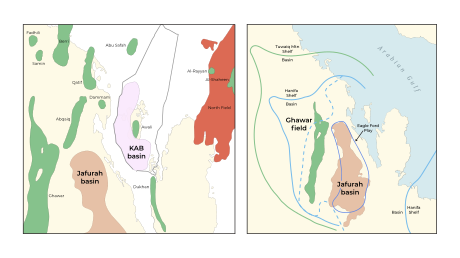
The development of the largest unconventional gas field located in the Jafurah Basin in Saudi Arabia (Figure 1) was assessed using public pilot data, Eagle Ford wet-gas analogs and engineering assumptions. The development requiring wells, gathering pipelines, liquids processing and underground gas storage before production start-up. This made it a strong example of why economic appraisal must connect reservoir uncertainty, development timing, infrastructure and product-market assumptions.
Figure 1 – Jafurah Basin location and scale compared with the Eagle Ford analog.
The appraisal used pilot data, Eagle Ford wet-gas analogs and probabilistic inputs to quantify NPV10, IRR, payout, maximum negative cash flow, profitability index and economic-limit year. The value of the workflow is that it does not ask management to trust one deterministic result; it shows the probability range and highlights the assumptions that control the investment case.
The analysis demonstrated why single deterministic appraisals are insufficient for large unconventional programs where well performance, gas-oil ratio, price, CAPEX and OPEX remain uncertain.
Objective
The objective was to translate uncertain pilot and analog data into decision-grade economic ranges before major development capital was committed. The study compared probabilistic appraisal results with a prior deterministic benchmark and identified which operational or commercial variables most affected value, payout and cash exposure. In client terms, the goal was to move from a single forecast to a management-ready decision range: downside, base case, upside and the drivers that can be acted on.
Provided Solution
The model combined decline-curve production forecasting with a discounted cash-flow model over a 40-year evaluation window. Raw well output was allocated into product streams including natural gas, ethane, natural gas liquids and condensate/natural gasoline. This is important for clients because full-field value is not determined by raw gas volume alone; the liquids yield, gas-oil ratio, ethane/NGL split, product price, and CAPEX and OPEX assumptions all influence revenue, infrastructure needs and economic ranking.
The probabilistic case assumed a fast-paced full-field development program of 10,000 wells drilled over 10 years and used 10,000 Monte Carlo simulations. The model assigned probability distributions to the main uncertain inputs, including production rate, gas-oil ratio, natural gas price, drilling and completion cost, and fixed operating expenditure, allowing the economics to be reported as P90, P50 and P10 outcomes rather than as a single point estimate.
For a client, this workflow is directly transferable. The same structure can be applied to a new shale or condensate play, a brownfield re-appraisal, a corporate reserves review, a development financing decision or an acquisition screen. The model shows whether value is robust, where the downside cash exposure sits, and which technical or commercial assumptions should be tested first.
Results and Findings
The probabilistic analysis produced a wide but commercially useful range of outcomes. The P90 case remained profitable with NPV10 of $7.45 billion and IRR of 13.8%, while the P50 case generated NPV10 of $47.21 billion and IRR of 46.8%. Payout was 10 years in the P90 case and 4 years in the P50 case. These values were compared to a prior deterministic benchmark of $15.97 billion NPV10, 26.34% IRR and 12.4-year payout. The P50 maximum negative cash-flow exposure was $7.50 billion, a planning metric that matters for liquidity, debt capacity and capital phasing. These results show why a full-field appraisal must report not only value, but also the amount of capital that must be carried before the project becomes self-funding.
The key finding was not simply that the P50 project value was attractive. The stronger message is that the probabilistic method made the uncertainty visible and actionable because deterministic cannot account for any uncertainty in either the operational or financial input parameters, whereas the probabilistic workflow quantified the downside case, upside case, payout period and capital exposure. For client decisions, that comparison demonstrates why the appraisal method can materially influence how a development is ranked, financed and phased.
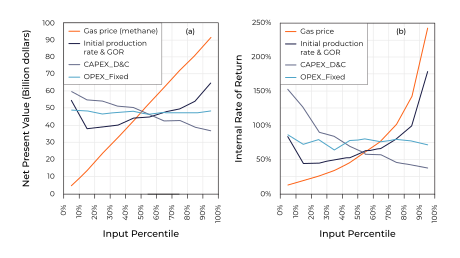
Figure 2 explains which assumptions matter most. Gas price was the dominant driver of NPV10 and IRR. Initial production rate and gas-oil ratio also influenced value because they control early production and liquids revenue. Drilling and completion capital expenditure had a strong effect on payout and capital exposure. Fixed operating expenditure had a smaller influence in the plotted ranges. This is the type of insight a client needs before committing capital: management can focus data acquisition, commercial negotiation and engineering optimization on the variables that have the greatest impact on value.
Figures 2 – Spider sensitivity analysis showing the impact of input parameter uncertainty to project economics
In short, a large full-field development cannot be appraised with reservoir forecasts alone. The investment depends on how well performance, product yields, development speed, infrastructure availability, price uncertainty and capital exposure interact. A repeatable appraisal model allows the client to re-run the decision as new wells come online, costs change, market conditions shift or infrastructure capacity is revised. That update loop supports better field development, completion design, production optimization and capital allocation. Overall, a probabilistic workflow gives management more useful decision ranges than a single deterministic base case.
Peer-reviewed studies further demonstrating the reliability and technical validity of Gaussian technology.
A probabilistic appraisal of Project Greensand: Economic viability of offshore geological CO₂ storage under uncertainty.
Weijermars, R., Budiman, O., Al-Raeeini, K., Astsauri, T.February 23, 2026ScienceDirect
This study presents an economic appraisal of Project Greensand in the Danish North Sea, a leading offshore CO₂ storage initiative that conducted injection pilot tests in 2023 and is slated for further development. Deterministic results indicate that, at concurrent CO₂ prices in the EU Emissions Trading System (ETS) of approximately $75.6/t, Greensand will be unprofitable, with a negative cumulative cash flow of about $6 million over its 10-year injection period. However, when considering certain price guarantees, the effective CO₂ price rises to ∼$113/t, which significantly increases the internal rate of return (IRR) to ∼21.8% , thereby surpassing the 15% hurdle rate for minimum return on investment. A subsequent probabilistic cash flow analysis revealed a pronounced downside risk profile, with a median IRR of 12.9%. Only under favorable assumptions of uncertain input parameters will the IRR exceed 15%. Our findings establish reference conditions for the price boundaries required to make offshore geological carbon storage (GCS) projects like Greensand bankable. Further sensitivity analyses of outcomes to variability in input parameters confirm that well and platform operating expenditure, shipping capital expenditure, and all-in revenue are the dominant value drivers. Likewise, the methodology employed in this study emphasizes the importance of probabilistic appraisal to adequately capture risk and uncertainty when developing and implementing effective policy support mechanisms for the early deployment of offshore GCS projects.This study presents an economic appraisal of Project Greensand in the Danish North Sea, a leading offshore CO₂ storage initiative that conducted injection pilot tests in 2023 and is slated for further development. Deterministic results indicate that, at concurrent CO₂ prices in the EU Emissions Trading System (ETS) of approximately $75.6/t, Greensand will be unprofitable, with a negative cumulative cash flow of about $6 million over its 10-year injection period. However, when considering certain price guarantees, the effective CO₂ price rises to ∼$113/t, which significantly increases the internal rate of return (IRR) to ∼21.8% , thereby surpassing the 15% hurdle rate for minimum return on investment. A subsequent probabilistic cash flow analysis revealed a pronounced downside risk profile, with a median IRR of 12.9%. Only under favorable assumptions of uncertain input parameters will the IRR exceed 15%. Our findings establish reference conditions for the price boundaries required to make offshore geological carbon storage (GCS) projects like Greensand bankable. Further sensitivity analyses of outcomes to variability in input parameters confirm that well and platform operating expenditure, shipping capital expenditure, and all-in revenue are the dominant value drivers. Likewise, the methodology employed in this study emphasizes the importance of probabilistic appraisal to adequately capture risk and uncertainty when developing and implementing effective policy support mechanisms for the early deployment of offshore GCS projects.
Economic Appraisal for an Unconventional Condensate Play Prior to Field Development: Jafurah Basin Case Study (Saudi Arabia)
Jin, M., and Weijermars, R.July 1, 2022Journal of Natural Gas Science and Engineering
This study uses a stochastic approach to provide a holistic economic evaluation of the Jafurah field development project, the largest unconventional natural gas field in Saudi Arabia, projected to start first production in 2024. The assessment considers deterministic and probabilistic inputs based on data published in the literature, analogy with Eagle Ford reservoir parameters, and engineering-based assumptions. The uncertainty of discounted net cash flow, internal rate of return, and other target metrics for the Jafurah project is quantified (P90, P50, and P10). The results show the most likely (P50) net present value of 47.21 billion US dollars (at 10% discount rate) and a corresponding internal rate of return of 46.8%. Sensitivity analysis highlights the relative importance of the most critical probabilistic inputs (initial production rate, natural gas price, capital and operational expenses). Based on the current economic ranges and uncertainty analysis, it can be concluded that the Jafurah Field can be profitable in the long term. However, frequent reappraisals are recommended to help direct future decisions on capital expenditure programs for the drilling and completion of new wells, especially when new field performance data becomes available after the earlier wells start first production in 2024. Although hundreds of field delineation and production wells have already been drilled and completed over the past decade, major investment and time were needed to construct new regional pipelines (for gathering natural gas and liquids from each well pad), new chemical plants (for processing of the natural gas liquids), and new underground natural gas storage facilities (to buffer seasonal changes in the production supply and demand of natural gas), which is why first production is planned for 2024.This study uses a stochastic approach to provide a holistic economic evaluation of the Jafurah field development project, the largest unconventional natural gas field in Saudi Arabia, projected to start first production in 2024. The assessment considers deterministic and probabilistic inputs based on data published in the literature, analogy with Eagle Ford reservoir parameters, and engineering-based assumptions. The uncertainty of discounted net cash flow, internal rate of return, and other target metrics for the Jafurah project is quantified (P90, P50, and P10). The results show the most likely (P50) net present value of 47.21 billion US dollars (at 10% discount rate) and a corresponding internal rate of return of 46.8%. Sensitivity analysis highlights the relative importance of the most critical probabilistic inputs (initial production rate, natural gas price, capital and operational expenses). Based on the current economic ranges and uncertainty analysis, it can be concluded that the Jafurah Field can be profitable in the long term. However, frequent reappraisals are recommended to help direct future decisions on capital expenditure programs for the drilling and completion of new wells, especially when new field performance data becomes available after the earlier wells start first production in 2024. Although hundreds of field delineation and production wells have already been drilled and completed over the past decade, major investment and time were needed to construct new regional pipelines (for gathering natural gas and liquids from each well pad), new chemical plants (for processing of the natural gas liquids), and new underground natural gas storage facilities (to buffer seasonal changes in the production supply and demand of natural gas), which is why first production is planned for 2024.
Probabilistic Techno-Economic Appraisal of Prospective Hydrocarbon Resources in Five Turbidites, Offshore Uruguay
Rodriguez, P., Ferro, S., and Weijermars, R.October 19, 2019OnePetro
This paper presents a probabilistic techno-economic evaluation of several turbidite prospects recognized, through 3D seismic, in deep to ultra-deep water of the Punta del Este and Pelotas sedimentary basins, offshore of Uruguay. The production potential of many prospective turbidite reservoirs on the Atlantic margin has been recognized before, and new turbidite prospects were identified in Uruguay’s maritime zone after analyzing data from the world’s deepest water-depth well (Raya-X1) drilled in 2016.
The estimated ultimate recovery of oil and gas was determined, for each prospect, by carrying out probabilistic resource analyses (Monte Carlo simulations) using 3D seismic and key parameters from analog turbidite fields located in sedimentary basins along the Atlantic margin. Black oil fluid was assumed and the production concept involves FPSO vessels. The produced oil would be exported via tankers and the associated gas would be either sent to shore through a gas pipeline, or re-injected into the formation. For the economic evaluation, the latest fiscal terms of the applicable production-sharing contract, for offshore assets in Uruguay, were considered.
The outcomes of the probabilistic economic analyses include, for each prospect, several key performance indicators such as: net present value, internal rate of return, maximum negative cash flow, breakeven oil price, government take and entitlement percentage of hydrocarbons. These indicators were determined after running Monte Carlo simulations, which considered probability distribution functions for fixed and variable capital and operational expenditures, along with well productivities and decline rates. Regarding the economics of the project, several scenarios of incremental profit oil for the government and maximum association percentage for ANCAP, the National Oil Company of Uruguay, were evaluated. The cases considered show how key negotiables and variables, featuring in the tender process offered to oil companies interested in Uruguay’s offshore hydrocarbon assets, may affect the economics and development solutions of a typical field development project. Considering a plausible base case of 20% ANCAP association and no incremental profit oil for the state, the results show that, for the biggest prospects, the breakeven oil price is situated near 60 USD/bbl. The analysis also shows that the smaller prospects would need to be developed as satellites of the nearby principal prospects in order to become attractive for development.
This study sheds light on the exploration potential of turbidites, offshore of Uruguay, and analyzed resource volumes, production profiles and economic returns of a hypothetic development in the case of a commercial discovery. The analyses provide useful templates for international oil companies, which, under the new and more flexible Uruguay Open Round licensing regime, may be interested in the exploration and imminent development of the Uruguayan offshore sedimentary basins.This paper presents a probabilistic techno-economic evaluation of several turbidite prospects recognized, through 3D seismic, in deep to ultra-deep water of the Punta del Este and Pelotas sedimentary basins, offshore of Uruguay. The production potential of many prospective turbidite reservoirs on the Atlantic margin has been recognized before, and new turbidite prospects were identified in Uruguay’s maritime zone after analyzing data from the world’s deepest water-depth well (Raya-X1) drilled in 2016.
The estimated ultimate recovery of oil and gas was determined, for each prospect, by carrying out probabilistic resource analyses (Monte Carlo simulations) using 3D seismic and key parameters from analog turbidite fields located in sedimentary basins along the Atlantic margin. Black oil fluid was assumed and the production concept involves FPSO vessels. The produced oil would be exported via tankers and the associated gas would be either sent to shore through a gas pipeline, or re-injected into the formation. For the economic evaluation, the latest fiscal terms of the applicable production-sharing contract, for offshore assets in Uruguay, were considered.
The outcomes of the probabilistic economic analyses include, for each prospect, several key performance indicators such as: net present value, internal rate of return, maximum negative cash flow, breakeven oil price, government take and entitlement percentage of hydrocarbons. These indicators were determined after running Monte Carlo simulations, which considered probability distribution functions for fixed and variable capital and operational expenditures, along with well productivities and decline rates. Regarding the economics of the project, several scenarios of incremental profit oil for the government and maximum association percentage for ANCAP, the National Oil Company of Uruguay, were evaluated. The cases considered show how key negotiables and variables, featuring in the tender process offered to oil companies interested in Uruguay’s offshore hydrocarbon assets, may affect the economics and development solutions of a typical field development project. Considering a plausible base case of 20% ANCAP association and no incremental profit oil for the state, the results show that, for the biggest prospects, the breakeven oil price is situated near 60 USD/bbl. The analysis also shows that the smaller prospects would need to be developed as satellites of the nearby principal prospects in order to become attractive for development.
This study sheds light on the exploration potential of turbidites, offshore of Uruguay, and analyzed resource volumes, production profiles and economic returns of a hypothetic development in the case of a commercial discovery. The analyses provide useful templates for international oil companies, which, under the new and more flexible Uruguay Open Round licensing regime, may be interested in the exploration and imminent development of the Uruguayan offshore sedimentary basins.
Economic Appraisal and Scoping of Geothermal Extraction Projects using Depleted Hydrocarbon Wells
Westphal, D. and Weijermars, R.November 1, 2018Energy Strategy Reviews
This study offers a first step in examining a potential solution for what to do with the ever-increasing number of horizontal shale wells in the United States (and lately, Argentina and China), as they come to the end of their economic life. A comprehensive decision-making tool was developed for scoping assessments based on the technical and economic appraisal of abandoned hydrocarbon wells repurposed into enhanced geothermal systems. We specifically target near end-of-life oil and gas wells, re-commissioned to extract geothermal energy as opposed to hydrocarbons, because these potential geothermal resources are prevalent near a handful of major US population and energy demand centers, including Pittsburgh, Houston, Denver, Dallas, Oklahoma City and San Antonio. This study addresses some of the technical challenges associated with such projects. However, the main focus is on (1) the probabilistic evaluation of the economic net present value, and (2) specific solutions for possible commercial deal structures required for negotiation and project implementation. The backdrop for the test case in this study is the new Texas A&M RELLIS Campus being constructed in College Station, Texas. A successful commercial model for the use of abandoned oil and gas wells to extract low and medium temperature geothermal resources could spur further development and a pilot study is proposed for this green source of energy. Our estimations suggest a net present value of $1.2 billion could be unlocked in the US alone, through the repurposing of wells, previously used for hydrocarbon extraction only.This study offers a first step in examining a potential solution for what to do with the ever-increasing number of horizontal shale wells in the United States (and lately, Argentina and China), as they come to the end of their economic life. A comprehensive decision-making tool was developed for scoping assessments based on the technical and economic appraisal of abandoned hydrocarbon wells repurposed into enhanced geothermal systems. We specifically target near end-of-life oil and gas wells, re-commissioned to extract geothermal energy as opposed to hydrocarbons, because these potential geothermal resources are prevalent near a handful of major US population and energy demand centers, including Pittsburgh, Houston, Denver, Dallas, Oklahoma City and San Antonio. This study addresses some of the technical challenges associated with such projects. However, the main focus is on (1) the probabilistic evaluation of the economic net present value, and (2) specific solutions for possible commercial deal structures required for negotiation and project implementation. The backdrop for the test case in this study is the new Texas A&M RELLIS Campus being constructed in College Station, Texas. A successful commercial model for the use of abandoned oil and gas wells to extract low and medium temperature geothermal resources could spur further development and a pilot study is proposed for this green source of energy. Our estimations suggest a net present value of $1.2 billion could be unlocked in the US alone, through the repurposing of wells, previously used for hydrocarbon extraction only.
Economic Benchmark of Deepwater field development projects in the Perdido fold belt at either side of the U.S.-Mexico Transboundary Zone: Which fiscal regime offers the most competitive return on investment?
Weijermars, R., Alves, I., Rowan, M., and Blasco Flores, D.October 1, 2017Energy Policy
Development of Mexican hydrocarbon reservoirs by foreign operators is now made possible by the energy reforms implemented in 2015. This study benchmarks the economic return of deepwater hydrocarbon field development projects located in the Perdido foldbelt at either side of the maritime border between the United States and Mexico to assess the competitiveness of the respective fiscal frameworks. We use a nodal analysis production model to first history match real field performance in the US Perdido project and then forecast production of an analogous, undeveloped field in the Mexican extension of the Perdido foldbelt, Gulf of Mexico. The new Mexican profit sharing contract imposes basic royalties that appear equitable for both the contractor and the government, albeit slightly less attractive than the to the U.S. federal lease terms. The contracts for deepwater assets in Mexico open up commercially viable options, provided the oil price will recover to render such oil projects profitable. Our sensitivity analysis shows that profitable development of 300 MMbbls oil in place becomes possible when oil prices rise above $75/bbl. For larger reservoirs (~900 MMbbls) the profit hurdle rate of 15% is already met for $60/bbl. Any over-royalty offered by a contractor in the bidding process renders the royalties in Mexican operations slightly higher than in the U.S.Development of Mexican hydrocarbon reservoirs by foreign operators is now made possible by the energy reforms implemented in 2015. This study benchmarks the economic return of deepwater hydrocarbon field development projects located in the Perdido foldbelt at either side of the maritime border between the United States and Mexico to assess the competitiveness of the respective fiscal frameworks. We use a nodal analysis production model to first history match real field performance in the US Perdido project and then forecast production of an analogous, undeveloped field in the Mexican extension of the Perdido foldbelt, Gulf of Mexico. The new Mexican profit sharing contract imposes basic royalties that appear equitable for both the contractor and the government, albeit slightly less attractive than the to the U.S. federal lease terms. The contracts for deepwater assets in Mexico open up commercially viable options, provided the oil price will recover to render such oil projects profitable. Our sensitivity analysis shows that profitable development of 300 MMbbls oil in place becomes possible when oil prices rise above $75/bbl. For larger reservoirs (~900 MMbbls) the profit hurdle rate of 15% is already met for $60/bbl. Any over-royalty offered by a contractor in the bidding process renders the royalties in Mexican operations slightly higher than in the U.S.
Re-appraisal of the Bakken Shale Play: Accounting for Historic and Future Oil Prices and applying Fiscal Rates in North Dakota, Montana and Saskatchewan
Weijermars, R., Paradis, K., Belostrino, E., Feng, F., Lal, T. , Xie, A., and Villareal, C.June 1, 2017Energy Strategy Reviews
The ascent of the Bakken shale play as a major U.S. oil producer became threatened by the 2014–2016 oil price fall. This benchmark study assesses and compares the economic performance of typical Bakken wells across three different fiscal regimes: North Dakota (ND) and Montana (MT) in the U.S., and the Canadian province of Saskatchewan (SK). Decline curve analysis and discounted cash flow analysis are applied to evaluate and re-appraise both the productivity and economic performance (internal rate of return, IRR) of typical Bakken wells in each region. For wells of similar estimated ultimate recovery (EUR), the fiscal regime of Montana (IRR 27%) is slightly more advantageous than North Dakota’s (IRR 24%). If wells can be identified in SK akin to ND’s reference well of 555 Mbbls EUR, the Canadian province provides the most attractive after tax return (180%). However, type curves for Bakken wells in SK and MT analyzed in our study typically have EURs at only 14% and 37% of the ND reference well (EUR∼555 Mbbls) and IRRs adjusted for EUR in MT and SK are negative in both regions at the historic reference price of $80/bbl. A sensitivity analysis using oil prices ranging between $20–100/bbl accounts for any of the price levels seen in the 2014–2016 price fall, and can be projected forward. The evaluation of single well economics and sensitivity to oil price changes and drilling and completion cost is subsequently expanded with a representative firm approach considering certain asset development options with multiple wells in each of the three Bakken jurisdictions (ND, MT, SK).The ascent of the Bakken shale play as a major U.S. oil producer became threatened by the 2014–2016 oil price fall. This benchmark study assesses and compares the economic performance of typical Bakken wells across three different fiscal regimes: North Dakota (ND) and Montana (MT) in the U.S., and the Canadian province of Saskatchewan (SK). Decline curve analysis and discounted cash flow analysis are applied to evaluate and re-appraise both the productivity and economic performance (internal rate of return, IRR) of typical Bakken wells in each region. For wells of similar estimated ultimate recovery (EUR), the fiscal regime of Montana (IRR 27%) is slightly more advantageous than North Dakota’s (IRR 24%). If wells can be identified in SK akin to ND’s reference well of 555 Mbbls EUR, the Canadian province provides the most attractive after tax return (180%). However, type curves for Bakken wells in SK and MT analyzed in our study typically have EURs at only 14% and 37% of the ND reference well (EUR∼555 Mbbls) and IRRs adjusted for EUR in MT and SK are negative in both regions at the historic reference price of $80/bbl. A sensitivity analysis using oil prices ranging between $20–100/bbl accounts for any of the price levels seen in the 2014–2016 price fall, and can be projected forward. The evaluation of single well economics and sensitivity to oil price changes and drilling and completion cost is subsequently expanded with a representative firm approach considering certain asset development options with multiple wells in each of the three Bakken jurisdictions (ND, MT, SK).
Eagle Ford Shale Play Economics: U.S. versus Mexico
Weijermars, R., Sorek, N., Seng, D., and Ayers, W.February 1, 2017Journal of Natural Gas Science and Engineering
The decline of domestic natural gas supply and rising demand requires Mexico to import 1/3 of its annual gas consumption of 2.5 trillion cubic feet (Tcf). Yet, Mexico’s estimated resource of technically recoverable shale gas (545 Tcf) is the 6th largest such gas resource in the World. Much of Mexico’s shale gas resource is in the Eagle Ford Shale, which is a mature shale gas and oil play in the U.S. To aid in determination of whether development of the Eagle Ford Shale in Mexico could reduce the country’s dependency on natural gas imports, we evaluated the potential of Mexican shale acreage by comparing the after-tax net present value (NPV) and internal rate of return (IRR) of Eagle Ford shale wells on either side of the U.S.-Mexico border. The initial development of Mexican acreage occurs with a much larger well-spacing (leading to higher acreage acquisition cost per well), which would require 25% higher development cost as compared to Texas acreage. Consequentially, Texas wells have better net present value (NPV) and higher internal rate of return (IRR) than Mexican wells, in general. The principal explanation is that the signing bonus will be much higher in Mexico than in Texas, partly effectuated by the lower well spacing for unrisked acreage. Results of our study provide potential operators and investors with a preliminary indication of Eagle Ford Shale well economics in Mexico. Our study includes sensitivity analyses for both non-escalated and escalated gas prices, for drilling and completion (D&C) costs, and for leasehold cost. The economic appraisal accounts for both single- and multiple-well development scenarios with P10, P50 and P90 production forecasts.The decline of domestic natural gas supply and rising demand requires Mexico to import 1/3 of its annual gas consumption of 2.5 trillion cubic feet (Tcf). Yet, Mexico’s estimated resource of technically recoverable shale gas (545 Tcf) is the 6th largest such gas resource in the World. Much of Mexico’s shale gas resource is in the Eagle Ford Shale, which is a mature shale gas and oil play in the U.S. To aid in determination of whether development of the Eagle Ford Shale in Mexico could reduce the country’s dependency on natural gas imports, we evaluated the potential of Mexican shale acreage by comparing the after-tax net present value (NPV) and internal rate of return (IRR) of Eagle Ford shale wells on either side of the U.S.-Mexico border. The initial development of Mexican acreage occurs with a much larger well-spacing (leading to higher acreage acquisition cost per well), which would require 25% higher development cost as compared to Texas acreage. Consequentially, Texas wells have better net present value (NPV) and higher internal rate of return (IRR) than Mexican wells, in general. The principal explanation is that the signing bonus will be much higher in Mexico than in Texas, partly effectuated by the lower well spacing for unrisked acreage. Results of our study provide potential operators and investors with a preliminary indication of Eagle Ford Shale well economics in Mexico. Our study includes sensitivity analyses for both non-escalated and escalated gas prices, for drilling and completion (D&C) costs, and for leasehold cost. The economic appraisal accounts for both single- and multiple-well development scenarios with P10, P50 and P90 production forecasts.
Competitiveness of shallow water hydrocarbon development projects in Mexico after 2015 actualization of fiscal reforms: Economic benchmark of new production sharing agreement versus typical U.S. federal lease terms
Weijermars, R. and Zhai, J.September 1, 2016Energy Policy
Development of Mexican hydrocarbon reservoirs by foreign operators has become possible under Mexico’s new Hydrocarbon Law, effective as per January 2015. Our study compares the economic returns of shallow water fields in the Gulf of Mexico applying the royalty and taxes due under the fiscal regimes of the U.S. and Mexico. The net present value (NPV) of the base case scenario is US$1.4 billion, assuming standard development and production cost (opex, capex), 10% discount rate accounting for the cost of capital and revenues computed using a reference oil price of $75/bbl. The impact on NPV of oil price volatility is accounted for in a sensitivity analysis. The split of the NPV of shallow water hydrocarbon assets between the two contractual parties, contractor and government, in Mexico and the U.S. is hugely different. Our base case shows that for similar field assets, Mexico’s production sharing agreement allocates about $1,150 million to the government and $191 million to the contractor, while under U.S. license conditions the government take is about $700 million and contractor take is $553 million. The current production sharing agreement leaves some marginal shallow water fields in Mexico undeveloped for reasons detailed and quantified in our study.Development of Mexican hydrocarbon reservoirs by foreign operators has become possible under Mexico’s new Hydrocarbon Law, effective as per January 2015. Our study compares the economic returns of shallow water fields in the Gulf of Mexico applying the royalty and taxes due under the fiscal regimes of the U.S. and Mexico. The net present value (NPV) of the base case scenario is US$1.4 billion, assuming standard development and production cost (opex, capex), 10% discount rate accounting for the cost of capital and revenues computed using a reference oil price of $75/bbl. The impact on NPV of oil price volatility is accounted for in a sensitivity analysis. The split of the NPV of shallow water hydrocarbon assets between the two contractual parties, contractor and government, in Mexico and the U.S. is hugely different. Our base case shows that for similar field assets, Mexico’s production sharing agreement allocates about $1,150 million to the government and $191 million to the contractor, while under U.S. license conditions the government take is about $700 million and contractor take is $553 million. The current production sharing agreement leaves some marginal shallow water fields in Mexico undeveloped for reasons detailed and quantified in our study.
Economic appraisal of shale plays in Continental Europe
Weijermars, R.September 1, 2016Applied Energy
Development of Mexican hydrocarbon reservoirs by foreign operators has become possible under Mexico’s new Hydrocarbon Law, effective as per January 2015. Our study compares the economic returns of shallow water fields in the Gulf of Mexico applying the royalty and taxes due under the fiscal regimes of the U.S. and Mexico. The net present value (NPV) of the base case scenario is US$1.4 billion, assuming standard development and production cost (opex, capex), 10% discount rate accounting for the cost of capital and revenues computed using a reference oil price of $75/bbl. The impact on NPV of oil price volatility is accounted for in a sensitivity analysis. The split of the NPV of shallow water hydrocarbon assets between the two contractual parties, contractor and government, in Mexico and the U.S. is hugely different. Our base case shows that for similar field assets, Mexico’s production sharing agreement allocates about $1,150 million to the government and $191 million to the contractor, while under U.S. license conditions the government take is about $700 million and contractor take is $553 million. The current production sharing agreement leaves some marginal shallow water fields in Mexico undeveloped for reasons detailed and quantified in our study.Development of Mexican hydrocarbon reservoirs by foreign operators has become possible under Mexico’s new Hydrocarbon Law, effective as per January 2015. Our study compares the economic returns of shallow water fields in the Gulf of Mexico applying the royalty and taxes due under the fiscal regimes of the U.S. and Mexico. The net present value (NPV) of the base case scenario is US$1.4 billion, assuming standard development and production cost (opex, capex), 10% discount rate accounting for the cost of capital and revenues computed using a reference oil price of $75/bbl. The impact on NPV of oil price volatility is accounted for in a sensitivity analysis. The split of the NPV of shallow water hydrocarbon assets between the two contractual parties, contractor and government, in Mexico and the U.S. is hugely different. Our base case shows that for similar field assets, Mexico’s production sharing agreement allocates about $1,150 million to the government and $191 million to the contractor, while under U.S. license conditions the government take is about $700 million and contractor take is $553 million. The current production sharing agreement leaves some marginal shallow water fields in Mexico undeveloped for reasons detailed and quantified in our study.
Assessing the economic margins of sweet spots in shale gas plays
Weijermars, R. and Van der Linden, J.December 1, 2012First Break
Ruud Weijermars and Joost van der Linden outline a new reality for shale gas plays where even sweet spots may become sub-economic when gas prices collapse. The North American shale-gas bonanza is reviewed and sweet spot sensitivity to gas price volatility is illustrated for the Haynesville shale play. The second part of this article will follow in the January issue.Ruud Weijermars and Joost van der Linden outline a new reality for shale gas plays where even sweet spots may become sub-economic when gas prices collapse. The North American shale-gas bonanza is reviewed and sweet spot sensitivity to gas price volatility is illustrated for the Haynesville shale play. The second part of this article will follow in the January issue.
Unconventional Natural Gas Business: TSR Benchmark and Recommendations for Prudent Management of Shareholder Value
Weijermars, R., and Watson, S.November 14, 2011SPE-154056-MS
Summary Stock-listed independents have played a leading role in the development of unconventional natural-gas resources in the United States and Canada. Shareholders have provided up to 57% of the total capital tied up in a representative panel comprising the 20 leading US and Canadian operators. The accumulated equity-financed capital also provided the collateral for the complementary 43% debt financing. Prudent management of shareholder value in unconventional-gas businesses is therefore essential for ensuring security of gas supply, not only in North America, but also in other countries with emergent unconventional gas plays. This study analyzes and benchmarks the working capital cycles in unconventional-gas companies. The working capital and cashflow cycles are compared with those of diversified oil and gas majors. The ability to accumulate retained earnings is generally much lower for unconventional-gas producers than for integrated majors. Unconventional-gas producers tend to grow their share capital by new issues and not from economic value added by profit from business operations. Although little or no asset value is built from economic profit, shareholder returns may still grow for unconventional-gas companies as long as investor expectations remain positive about future earnings. In contrast, shareholder returns in conventional-gas companies come from genuine economic value added in profitable business operations. The root cause of the weakness or absence of operational profits in unconventional-gas operations is a combination of low gas prices and well flow rates that are too modest to pay for the total cost of the unconventional-gas production. The operating margins for unconventional-gas companies are either close to zero or negative, but not for the integrated oil and gas majors, which have impressive cash margins even at globally suppressed gas prices. The benchmarks provided here help one to understand which parameters impact the financial performance of unconventional-natural-gas companies most significantly. Recommendations are formulated to avoid the destruction of shareholder value, and to instead maximize total shareholder returns (TSRs).Summary Stock-listed independents have played a leading role in the development of unconventional natural-gas resources in the United States and Canada. Shareholders have provided up to 57% of the total capital tied up in a representative panel comprising the 20 leading US and Canadian operators. The accumulated equity-financed capital also provided the collateral for the complementary 43% debt financing. Prudent management of shareholder value in unconventional-gas businesses is therefore essential for ensuring security of gas supply, not only in North America, but also in other countries with emergent unconventional gas plays. This study analyzes and benchmarks the working capital cycles in unconventional-gas companies. The working capital and cashflow cycles are compared with those of diversified oil and gas majors. The ability to accumulate retained earnings is generally much lower for unconventional-gas producers than for integrated majors. Unconventional-gas producers tend to grow their share capital by new issues and not from economic value added by profit from business operations. Although little or no asset value is built from economic profit, shareholder returns may still grow for unconventional-gas companies as long as investor expectations remain positive about future earnings. In contrast, shareholder returns in conventional-gas companies come from genuine economic value added in profitable business operations. The root cause of the weakness or absence of operational profits in unconventional-gas operations is a combination of low gas prices and well flow rates that are too modest to pay for the total cost of the unconventional-gas production. The operating margins for unconventional-gas companies are either close to zero or negative, but not for the integrated oil and gas majors, which have impressive cash margins even at globally suppressed gas prices. The benchmarks provided here help one to understand which parameters impact the financial performance of unconventional-natural-gas companies most significantly. Recommendations are formulated to avoid the destruction of shareholder value, and to instead maximize total shareholder returns (TSRs).