Improving forecast reliability in a mature Gulf of Mexico reservoir
In a Gulf of Mexico field that had already produced more than 100 million barrels, our analysis corrected a misleading lab assumption that could have overstated future reservoir performance.
The revised analysis found about 6% recovery support from fluid expansion and potentially up to 30% more production from pressure-driven rock changes under the modeled conditions.
By aligning forecasts with actual field behavior, the study gives decision-makers a stronger basis for reserves estimates, field-life extension, pressure support, and CO₂-enhanced recovery investments.
Summary
A mature offshore sandstone reservoir in the Gulf of Mexico had already produced more than 100 million bbl and was being assessed for extended field life, including continued pressure support and possible CO2-EOR. The issue was not just decline forecasting. It was whether the reservoir model inputs being used for forecasting and reserves work were physically correct.
Objective
We re-examined earlier petrophysical interpretation that suggested porosity and permeability might increase as reservoir pressure declined. If accepted, that would imply improving reservoir quality during depletion. However, this interpretation conflicted with field evidence and with bulk-compressibility-based understanding that producing reservoirs compact as pressure falls. The main objective was therefore to test whether the apparent pore dilation seen in laboratory-style pore-volume compressibility data was real reservoir behavior or a misleading artifact.
Provided Solution
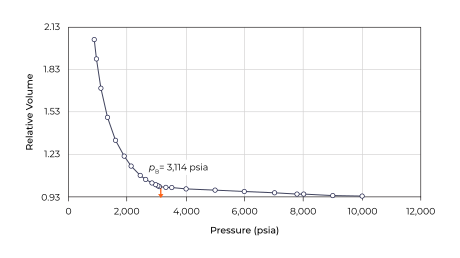
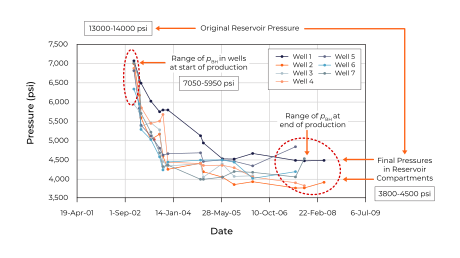
The reassessment integrated core-derived pore-volume compressibility data (Figure 1), reservoir fluid and PVT data, bottom-hole pressure history from nine producing wells, and analytical poro-elastic modeling.
Figure 1 – Reservoir-fluid expansion response during the depletion
Key field evidence showed that initial reservoir pressures was about 13,000–14,000 psi. Over time, flowing bottom-hole pressures declined and later stabilized around 4,000 psi after early depletion and pressure-management actions (Figure 2).
Figure 2 – Bottom-hole pressure decline history
Results and Findings
The PVT analysis showed that fluid compressibility increased as pressure declined, giving about 6.56% fluid-volume expansion from 10,000 psi down to the bubble-point pressure of 3,114 psi. This translates as roughly 6% recovery-factor support in the near-wellbore region from fluid expansion alone, before considering any poro-elastic contribution.
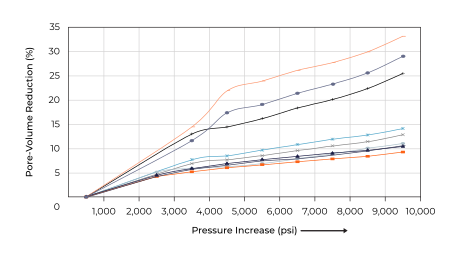
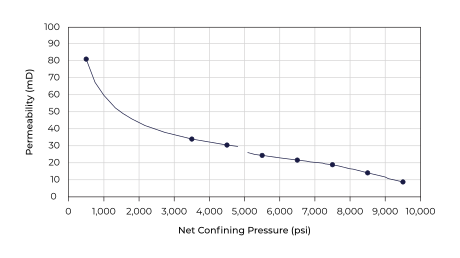
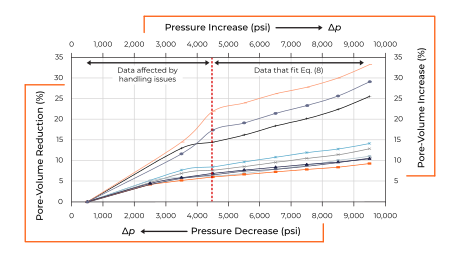
The core finding of our investigation is that earlier laboratory pore-volume compressibility trends suggested that pore volume increases as pressure declines (Figure 3), implying that permeability might improve during depletion as indicated in Figure 4. However, reinterpretation of pore-volume response suggested that this apparent dilation is not the correct reservoir interpretation.
Figure 3 – Pore-volume reduction with pressure increase
Instead, field evidence and analytical modelling indicate that pore compaction dominates during production depletion, not pore expansion. The misleading laboratory interpretation is attributed to a sign-reversal problem in how pore-volume compressibility is read and applied, with possible additional distortion from core handling damage during coring, unloading, drying, and re-pressurization.
Figure 4 – Apparent permeability response from lab interpretation
The corrected interpretation is captured most clearly in Figure 5, which shows that pore-volume reduction corresponds to production depletion, while pressure increase during injection corresponds to pore-volume expansion.
This matters because forecast models based on the incorrect interpretation could overstate permeability improvement and misrepresent pressure support behavior. For later-life development planning, that would affect reserves estimation, pressure-maintenance strategy, and screening of EOR or storage options.
Our analysis shows that poro-elastic relaxation may enhance well rates in deep reservoirs by up to 25% in general. For the Gulf of Mexico sandstone case, it further estimates that if porosity falls from about 33% to about 23% as reservoir pressure declines from 9,500 psi to 4,500 psi, then pore-fluid expulsion associated with pore collapse could add up to about 30% to the production stream relative to Darcy-based forecasting alone.
Overall, the analysis shows that improving forecast reliability in a mature reservoir may depend less on adding complexity and more on correcting the physical meaning of key inputs. In this case, the main improvement came from replacing a misleading depletion interpretation with one consistent with field pressure behavior, compaction mechanics, and poro-elastic response. That provides a stronger basis for production forecasting, reserves estimation, and later-life decisions on pressure support, EOR, and field-life extension.
Learn more about improving forecast reliability in a mature Gulf of Mexico reservoir
Peer-reviewed studies further demonstrating the reliability and technical validity of Gaussian technology.
Ultra-fast reservoir characterization and well-performance evaluation enabled by digital permeability twins
Weijermars, R., and Williams, G.March 1, 2026First Break
Industry practice for forecasting production rates of oil and gas wells is traditionally split between complex, physics-based simulators and empirical decline-curve analysis (DCA). Recently developed digital permeability twins coupled with closed-form Gaussian production models bridge the gap by offering a fast, physics-based alternative that avoids the over-parameterisation of numerical simulators while staying clear of the oversimplifications typical for purely empirical DCA approaches. Onshore and offshore case studies show that robust, production forecasts, well-design optimisation, and SPE compliant reserves classification can be achieved prior to drilling or history-matching limited production data (as little as one month). Applicable across diverse well and reservoir systems, fast decision-making is enabled through probabilistic well-performance forecasting, real-time and pre-drilling, while accurately representing the uncertainty in available data. Gaussian well-performance and resource evaluation thus provides a powerful new option for production analysis and reserves estimation under uncertainty, supporting optimisation efforts and enabling faster field-development decision-making without comprising accuracy.Industry practice for forecasting production rates of oil and gas wells is traditionally split between complex, physics-based simulators and empirical decline-curve analysis (DCA). Recently developed digital permeability twins coupled with closed-form Gaussian production models bridge the gap by offering a fast, physics-based alternative that avoids the over-parameterisation of numerical simulators while staying clear of the oversimplifications typical for purely empirical DCA approaches. Onshore and offshore case studies show that robust, production forecasts, well-design optimisation, and SPE compliant reserves classification can be achieved prior to drilling or history-matching limited production data (as little as one month). Applicable across diverse well and reservoir systems, fast decision-making is enabled through probabilistic well-performance forecasting, real-time and pre-drilling, while accurately representing the uncertainty in available data. Gaussian well-performance and resource evaluation thus provides a powerful new option for production analysis and reserves estimation under uncertainty, supporting optimisation efforts and enabling faster field-development decision-making without comprising accuracy.
Stiffening of Bulk Modulus in Poroelastic Medium with Rising Pore Pressure: A Comprehensive Sensitivity Study using a Closed-Form Solution Method
Toko, A.D.P., and Weijermars, R.September 11, 2025Computational Mathematical Modeling
This study presents high-resolution stress models of synthetic porous media consisting of regularly arranged cylindrical pores, with and without internal pressure. The stress distribution within the elastic solid matrix surrounding fluid-filled pores under uniaxial compressive stress is analyzed for: (1) drained conditions (negligible pore pressure) and (2) undrained conditions (with various pore pressures). A Linear Superposition Method (LSM) is applied to quantify elastic displacements and solve for the stress tensor field throughout the porous medium. Resolving for the pore-scale stresses in a poroelastic medium is relevant for diverse engineering disciplines. Oversimplified assumptions about the geometry and stress distribution can result in inaccurate predictions of mechanical behavior under different loading conditions. The study systematically investigates the effects of internal pressure, pore size, and porosity on the effective bulk modulus. Results reveal a non-linear, pressure-dependent relationship between bulk modulus and porosity. Notably, we identify a critical pressure state (PCRIT) where the bulk modulus becomes nearly independent of porosity. Beyond this point, a counterintuitive phenomenon of pressure-induced stiffening emerges under high pore pressure. Analysis of stress-strain distributions elucidates the mechanisms underlying this behavior. The new approach in this study for estimating macroscopic properties from microstructural parameters is highly applicable in designing durable engineering structures, optimizing geothermal and petroleum reservoir practices, and enhancing underground storage operations.This study presents high-resolution stress models of synthetic porous media consisting of regularly arranged cylindrical pores, with and without internal pressure. The stress distribution within the elastic solid matrix surrounding fluid-filled pores under uniaxial compressive stress is analyzed for: (1) drained conditions (negligible pore pressure) and (2) undrained conditions (with various pore pressures). A Linear Superposition Method (LSM) is applied to quantify elastic displacements and solve for the stress tensor field throughout the porous medium. Resolving for the pore-scale stresses in a poroelastic medium is relevant for diverse engineering disciplines. Oversimplified assumptions about the geometry and stress distribution can result in inaccurate predictions of mechanical behavior under different loading conditions. The study systematically investigates the effects of internal pressure, pore size, and porosity on the effective bulk modulus. Results reveal a non-linear, pressure-dependent relationship between bulk modulus and porosity. Notably, we identify a critical pressure state (PCRIT) where the bulk modulus becomes nearly independent of porosity. Beyond this point, a counterintuitive phenomenon of pressure-induced stiffening emerges under high pore pressure. Analysis of stress-strain distributions elucidates the mechanisms underlying this behavior. The new approach in this study for estimating macroscopic properties from microstructural parameters is highly applicable in designing durable engineering structures, optimizing geothermal and petroleum reservoir practices, and enhancing underground storage operations.
Evaluating Poro-Elastic Production Drive Mechanisms: Quantifying the Potential Contribution to Well-Rates and Risk of Core Handling Damage Inflating Pore-Volume Compressibility Measurements
Weijermars, R.September 1, 2025Energy Geoscience
By analyzing core data from an offshore Gulf of Mexico reservoir and developing analytical solutions, it can be demonstrated that laboratory measurements on pore-volume compressibility include artifacts, leading to a misinterpretation of porosity and permeability trends. A systematic evaluation of poro-elastic changes in pore volumes (and quantifying any consequent fluid expulsion during reservoir compaction) suggests that poro-elastic relaxation may enhance fluid production rates from deep reservoirs by up to 25 %. This value may be inadvertently inflated if the core samples used for pore-volume compressibility measurements suffered from handling damage. Nonetheless, poro-elastic fluid expulsion from the pores in producing reservoirs can provide additional lift and thus may enhance the recovery factor. Therefore, the possible contribution to well performance from poro-elastic production drive mechanisms ought to be carefully evaluated in reserves estimation. Reversely, injection wells may encounter poro-elastic suppression of injectivity due to elastic resistance, which would adversely affect the storage coefficient. By integrating geomechanical reservoir response with traditional fluid production models, reservoir model predictions of production under pressure depletion and injection conditions will be more accurate. The new insights reported here are essential for optimizing well performance, improving reservoir management, and extending the economic life of geological reservoirs. However, caution is warranted regarding pore-volume compressibility measurements. To what degree laboratory measurements of pore-volume compressibility measure true values or mainly record handling damage could not be conclusively settled in the present study.By analyzing core data from an offshore Gulf of Mexico reservoir and developing analytical solutions, it can be demonstrated that laboratory measurements on pore-volume compressibility include artifacts, leading to a misinterpretation of porosity and permeability trends. A systematic evaluation of poro-elastic changes in pore volumes (and quantifying any consequent fluid expulsion during reservoir compaction) suggests that poro-elastic relaxation may enhance fluid production rates from deep reservoirs by up to 25 %. This value may be inadvertently inflated if the core samples used for pore-volume compressibility measurements suffered from handling damage. Nonetheless, poro-elastic fluid expulsion from the pores in producing reservoirs can provide additional lift and thus may enhance the recovery factor. Therefore, the possible contribution to well performance from poro-elastic production drive mechanisms ought to be carefully evaluated in reserves estimation. Reversely, injection wells may encounter poro-elastic suppression of injectivity due to elastic resistance, which would adversely affect the storage coefficient. By integrating geomechanical reservoir response with traditional fluid production models, reservoir model predictions of production under pressure depletion and injection conditions will be more accurate. The new insights reported here are essential for optimizing well performance, improving reservoir management, and extending the economic life of geological reservoirs. However, caution is warranted regarding pore-volume compressibility measurements. To what degree laboratory measurements of pore-volume compressibility measure true values or mainly record handling damage could not be conclusively settled in the present study.
Beyond Biot – Nonlinear stiffening of the bulk modulus in fluid-saturated porous media
Toko, A.D.P., and Weijermars, R.June 1, 2025Results in Engineering
This paper comprehensively investigates the elastic behavior of fluid-saturated porous media, considering a far-field stress, a range of pore pressures, and varying pore sizes. A Linear Superposition Method (LSM) was used to quantify the stress distribution and effective bulk moduli within a synthetic micropore model under both drained and undrained conditions. Our a posteriori upscaling approach reveals a significant nonlinear stiffening of the bulk modulus with increasing pore pressure—up to 25 % in high-pressure regimes—driven by pore size, porosity, and localized stress concentrations, a behavior unpredicted by conventional poroelasticity theories reliant on a priori upscaling. Unlike Biot’s framework, which assumes uniform stress and linear softening with porosity, we demonstrate distinct stiffening regimes where elevated pressures enhance stiffness at higher porosity levels, challenging traditional assumptions. This elastic stiffening, quantified through closed-form solutions, emphasizes poroelasticity as a nonlinear, pore-scale process rather than a macroscopic property. A practical method is proposed for a posteriori upscaling of micropore model results into an analytical expression, for direct use in reservoir engineering operations, where huge variations in pore pressure may occur over the project-life of the reservoir, such as geological carbon sequestration. These findings provide a robust, predictive framework for understanding and managing porous media in dynamic subsurface environments.This paper comprehensively investigates the elastic behavior of fluid-saturated porous media, considering a far-field stress, a range of pore pressures, and varying pore sizes. A Linear Superposition Method (LSM) was used to quantify the stress distribution and effective bulk moduli within a synthetic micropore model under both drained and undrained conditions. Our a posteriori upscaling approach reveals a significant nonlinear stiffening of the bulk modulus with increasing pore pressure—up to 25 % in high-pressure regimes—driven by pore size, porosity, and localized stress concentrations, a behavior unpredicted by conventional poroelasticity theories reliant on a priori upscaling. Unlike Biot’s framework, which assumes uniform stress and linear softening with porosity, we demonstrate distinct stiffening regimes where elevated pressures enhance stiffness at higher porosity levels, challenging traditional assumptions. This elastic stiffening, quantified through closed-form solutions, emphasizes poroelasticity as a nonlinear, pore-scale process rather than a macroscopic property. A practical method is proposed for a posteriori upscaling of micropore model results into an analytical expression, for direct use in reservoir engineering operations, where huge variations in pore pressure may occur over the project-life of the reservoir, such as geological carbon sequestration. These findings provide a robust, predictive framework for understanding and managing porous media in dynamic subsurface environments.
Comprehensive Permeability-Transform Solutions for Shale and Sandstones using Data Sets from around the Globe
Weijermars, R.January 1, 2025Petroleum Research
This study uses 13 proprietary data sets from sedimentary basins around the globe to constrain the permeability and porosity ranges occupied by clastic rocks (sandstones and shale). The combined data sets represent a total sample size of 21,767 data pairs of measured porosity and permeability. The data are combined in various ways and analyzed in considerable detail, in what is presently assumed the most comprehensive permeability analysis of clastic data sets. First, comprehensive porosity-permeability transforms are plotted with the aim to understand how well the two quantities actually correlate, and what may be the root cause(s) of the huge variation in their correlation. The analysis of the empirical data is embedded in a review of prior work related to permeability transforms. The Kozeny-Carman relationship is revisited and a modified scaling approach is proposed. First, it is shown how hydraulics of pore tubes of various shapes and tortuosity relate to macroscopic permeability. The key scaling factor, called here the permeability-reduction factor, , is the ratio of the coefficient of hydraulically effective pore space, , and the tortuosity, . Whereas it is concluded that the porosity is a very poor predictor of the permeability, there appears to exist a close relationship between the permeability-reduction factor and the permeability, confirming the fundamental physical nature of as an excellent predictor of hydraulic transmissibility in porous media made up of sedimentary mineral aggregates. The inferred relationship provides the basis for a new method to construct permeability transforms, from bootstrapped data sets, using Monte-Carlo simulation.This study uses 13 proprietary data sets from sedimentary basins around the globe to constrain the permeability and porosity ranges occupied by clastic rocks (sandstones and shale). The combined data sets represent a total sample size of 21,767 data pairs of measured porosity and permeability. The data are combined in various ways and analyzed in considerable detail, in what is presently assumed the most comprehensive permeability analysis of clastic data sets. First, comprehensive porosity-permeability transforms are plotted with the aim to understand how well the two quantities actually correlate, and what may be the root cause(s) of the huge variation in their correlation. The analysis of the empirical data is embedded in a review of prior work related to permeability transforms. The Kozeny-Carman relationship is revisited and a modified scaling approach is proposed. First, it is shown how hydraulics of pore tubes of various shapes and tortuosity relate to macroscopic permeability. The key scaling factor, called here the permeability-reduction factor, , is the ratio of the coefficient of hydraulically effective pore space, , and the tortuosity, . Whereas it is concluded that the porosity is a very poor predictor of the permeability, there appears to exist a close relationship between the permeability-reduction factor and the permeability, confirming the fundamental physical nature of as an excellent predictor of hydraulic transmissibility in porous media made up of sedimentary mineral aggregates. The inferred relationship provides the basis for a new method to construct permeability transforms, from bootstrapped data sets, using Monte-Carlo simulation.
Advances in Stress-Strain Constitutive Models for Rock Failure: Review and New Dynamic Constitutive Failure (DCF) model using Core Data from the Tarim Basin (China)
A wide range of constitutive models exists to quantify how the applied forces will lead to breakdown of rock samples. This paper reviews the mechanical models that have been developed to capture the full stress-strain curve for rocks deforming first elastically and then failing by fracturing after an elastic limit has been reached. Existing models are poorly suited for application to rock samples subjected to extreme physical conditions, such as the mechanical behavior of rocks under high temperature and high stress as encountered in ultra-deep oil and gas wells. First, conventional triaxial rock mechanics experiments were carried out on core collected from a 7000 m deep reservoir in the Tarim Basin (China); the effects of temperature and confining pressure on rock mechanical properties were analyzed. After a review of existing stress-strain curve models, it was concluded that none of the current rock constitutive models can accurately describe the stress-strain curve of rocks under high temperature and high pressure. Therefore, a new constitutive model was developed to (1) describe the characteristics of pre-peak and post-peak failure curves, and (2) predict the full stress-strain curve at different temperatures and confining pressure. The model was calibrated with the experimental data from the Tarim well. A new constitutive model was obtained by assigning variables to the parameters of a dynamic constitutive failure (DCF) model, which can be used in other scenarios, such as compression failure of rock under cyclical loading, plastic deformation, and rock creep. The dynamic constitutive failure model first presented here provides a useful reference for future modeling attempts.A wide range of constitutive models exists to quantify how the applied forces will lead to breakdown of rock samples. This paper reviews the mechanical models that have been developed to capture the full stress-strain curve for rocks deforming first elastically and then failing by fracturing after an elastic limit has been reached. Existing models are poorly suited for application to rock samples subjected to extreme physical conditions, such as the mechanical behavior of rocks under high temperature and high stress as encountered in ultra-deep oil and gas wells. First, conventional triaxial rock mechanics experiments were carried out on core collected from a 7000 m deep reservoir in the Tarim Basin (China); the effects of temperature and confining pressure on rock mechanical properties were analyzed. After a review of existing stress-strain curve models, it was concluded that none of the current rock constitutive models can accurately describe the stress-strain curve of rocks under high temperature and high pressure. Therefore, a new constitutive model was developed to (1) describe the characteristics of pre-peak and post-peak failure curves, and (2) predict the full stress-strain curve at different temperatures and confining pressure. The model was calibrated with the experimental data from the Tarim well. A new constitutive model was obtained by assigning variables to the parameters of a dynamic constitutive failure (DCF) model, which can be used in other scenarios, such as compression failure of rock under cyclical loading, plastic deformation, and rock creep. The dynamic constitutive failure model first presented here provides a useful reference for future modeling attempts.
Hydraulic Diffusivity Estimations for US Shale Gas Reservoirs with Gaussian Method: Implications for Pore-Scale Diffusion Processes in Underground Repositories
Weijermars, R. and Afagwu, C.October 1, 2022Journal of Natural Gas Science and Engineering
This paper first presents so-called unified Gaussian solutions for the spatial advance of diffusion transients triggered by a sudden change in pressure, molecular mass concentration and/or temperature. The mathematical description with a Gaussian solution for the pressure transient is similar to that for molecular diffusion and quantifies the diffusion of pressure into the reservoir space due to a change in molecular density initiated at the well intervention point. The resulting pressure gradients due to the pressure transient quantify, via Darcy’s Law, the fluid-particle velocity resulting from that gradient everywhere in the reservoir. Also based on the Gaussian pressure transient, a Gaussian decline curve fitting formula is derived, uniquely scaled by the hydraulic diffusivity. The physics-based, Gaussian decline curve equation was utilized to match 30-year production data from 68 counties in four major US shale gas plays to compute their hydraulic diffusivities. The average hydraulic diffusivities of Marcellus, Haynesville-Bossier, Barnett and Utica shale are 7.43 × 10⁻⁹ m2 s−1, 7.9 × 10⁻⁹ m2 s−1, 12.3 × 10⁻⁹ m2 s−1, and 59.0 × 10⁻⁹ m2 s−1, respectively. The empirical history-matched estimates of the pressure-gradient-driven diffusion rates in shale are similar or faster than the shale diffusion-rates measured in the laboratory. It can be assumed that the empirical diffusion rate accounts for the integrated effects of Darcy and non-Darcy flow. Computation of the Gaussian Péclet number in gas plays confirms that the advective flux is much faster than the combined Fickean and non-Fickean mass transport rates. The implications for gas recovery from shale formations, and secure disposal of nuclear waste in the subsurface shale repositories (wellbores and cavities) are discussed. In particular, our field estimations being faster than the laboratory diffusion rates calls for caution because mass transport from leaking containers at disposal sites would diffuse several orders of magnitude faster than suggested by the slower laboratory rates.This paper first presents so-called unified Gaussian solutions for the spatial advance of diffusion transients triggered by a sudden change in pressure, molecular mass concentration and/or temperature. The mathematical description with a Gaussian solution for the pressure transient is similar to that for molecular diffusion and quantifies the diffusion of pressure into the reservoir space due to a change in molecular density initiated at the well intervention point. The resulting pressure gradients due to the pressure transient quantify, via Darcy’s Law, the fluid-particle velocity resulting from that gradient everywhere in the reservoir. Also based on the Gaussian pressure transient, a Gaussian decline curve fitting formula is derived, uniquely scaled by the hydraulic diffusivity. The physics-based, Gaussian decline curve equation was utilized to match 30-year production data from 68 counties in four major US shale gas plays to compute their hydraulic diffusivities. The average hydraulic diffusivities of Marcellus, Haynesville-Bossier, Barnett and Utica shale are 7.43 × 10⁻⁹ m2 s−1, 7.9 × 10⁻⁹ m2 s−1, 12.3 × 10⁻⁹ m2 s−1, and 59.0 × 10⁻⁹ m2 s−1, respectively. The empirical history-matched estimates of the pressure-gradient-driven diffusion rates in shale are similar or faster than the shale diffusion-rates measured in the laboratory. It can be assumed that the empirical diffusion rate accounts for the integrated effects of Darcy and non-Darcy flow. Computation of the Gaussian Péclet number in gas plays confirms that the advective flux is much faster than the combined Fickean and non-Fickean mass transport rates. The implications for gas recovery from shale formations, and secure disposal of nuclear waste in the subsurface shale repositories (wellbores and cavities) are discussed. In particular, our field estimations being faster than the laboratory diffusion rates calls for caution because mass transport from leaking containers at disposal sites would diffuse several orders of magnitude faster than suggested by the slower laboratory rates.