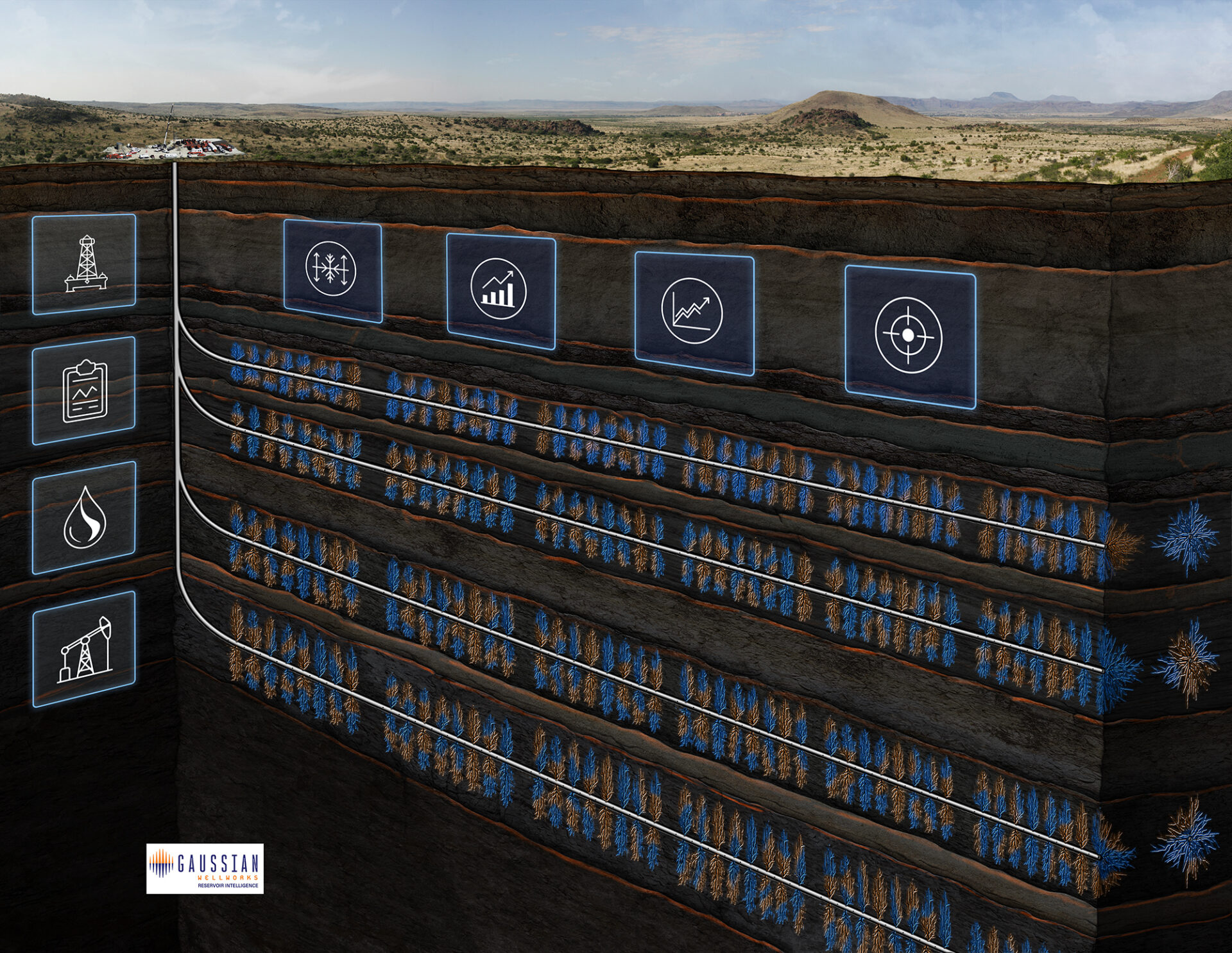
Physics-grounded fracture geometry and completion performance evaluation
Fracture diagnostics turns field data into quantitative fracture geometry and effectiveness estimates, with methods tailored to project maturity, data availability, and decisions from pre-drill design to post-production validation—providing decision-ready insight for completion design, well spacing, production forecasting, reserves evaluation, and next-well optimization.
Improves spacing, infill timing, parent-child risk, reserves confidence and capital allocation.
Diagnostic Methods
One service, four independent diagnostic methods — selected based on data availability and the decision being supported.
Pre-Drill Fracture Design & Optimization
Uses geomechanics and planned pumping parameters to estimate fracture geometry before execution and support stage spacing, cluster design, fluid, and proppant decisions.
Post-Frac Based Estimation
Uses pressure, rate, fluid, and proppant records to reconstruct stage-level fracture growth, geometry, and execution variability after pumping.
Flowback-Based Estimation
Uses flowback data to assess retained fracture volume, closure response, fracture capacity, and post-treatment effectiveness.
Early-Production GPT-Based Estimation
Uses early production and pressure behavior to estimate effective producing fracture geometry, stimulated area, and P90/P50/P10 ranges for forecasting.
Modeling Workflow
Our fracture diagnostics workflow offers a flexible, data-driven process to estimate fracture geometry and convert field data into development decisions. It chooses the best diagnostic pathway based on project goals, data, and outcomes; when multiple datasets exist, it compares methods to boost confidence and lower interpretation risk.
Define the objective
Identify the decision the analysis must support, such as fracture design, completion evaluation, forecasting, or well-spacing optimization, etc.
Review available data
Assess the quality and completeness of available reservoir, frac, flowback, or production data.
Select the diagnostic method
Choose the best-fit method based on project stage, data availability, and the required technical outcome.
Perform the analysis
Apply the selected physics-based method to estimate fracture geometry, half-length, stimulated area, or stage-level performance.
Validate the results
Vary key assumptions and uncertain parameters to determine their effect on the results. Confidence ranges are developed instead of relying on a single deterministic estimate.
Deliver recommendations
Translate the diagnostic results into clear guidance for completion design, forecasting, reserves, or development planning.
Client Receivables
Deliverables are tailored to the available data, project stage, and selected diagnostic method.
Operators
Effective fracture half-length and stimulated-area estimates.
Stage-level fracture geometry and execution diagnostics.
Inputs for completion design, well spacing, infill timing, and parent-child risk.
Forecast-ready inputs for production, EUR, and reserves analysis.
Investors & Lenders
P10/P50/P90 ranges for effective fracture half-length.
Risk-informed inputs for production forecasts, reserves, and asset valuation.
Technical support for asset screening, capital allocation, and financing decisions.
Regulators & Auditors
Traceable inputs, assumptions, and calculations.
Reproducible results with quantified uncertainty.
Documented method selection, workflow, and validation checks.
Review-ready technical documentation.
Proven Results in the Field
Stage-level fracture diagnostics from post-frac job reports for Eagle Ford shale
Gaussian converted routine post-frac reports of Eagle Ford 22-stage well into stage-level fracture dimensions and validated the result against independent production-history matches using CMG-IMEX, with only ~9.5% difference from GPT.
Read more peer-reviewed studies further demonstrating the reliability and technical validity of Gaussian technology.
Rapid Estimation of Fracture Half-Length and Fracture Propagation-Rate in Individual Hydraulic Fracturing Stages Using Post-Frac-Job Reports: Benchmark Results from Eagle Ford Case Study Well
Weijermars, R., and Oshaish, A.March 24, 2025
This study presents a practical method for estimating the propagation-rate and half-length of hydraulic fractures created in the individual fracturing Stages, using operational data recorded in so-called post-frac reports. The fluid volumes and pressures used during the actual pumping of individual fracturing Stages are routinely recorded in post-frac reports. However, these data are rarely analyzed in detail, and mostly serve as work-completion reports, based on which the service company that executed the hydraulic fracturing treatment will invoice the well owner. The new method elaborated here uses the hydraulic pressures and pumped volumes of frac fluid, as detailed in the frac-job reports. The required post-frac report data (from the actual completion job) and historic production rates were kindly availed by the operator, for this comprehensive case study using Eagle Ford well data. Starting from the pressures recorded at the wellhead, all the subsequent pressure gains and losses are computed as fluid moves toward the evolving fractures. The fluid pump-rate at the wellhead is also used in mass-balance calculations, considering fluid losses (if any) due to leak-off. The fracture propagation-rate and associated incremental growth of the fracture half-length and fracture width are quantified for all of the 22 Stages in the study well. The fracture half-lengths vary between 110 and 240 ft; the average fracture half-length is 157 ft. A back-check for accuracy of the new method is applied by comparing the average fracture half-length for the well obtained by averaging the Stage-based solutions (based on frac-report data) with independent solutions (based on history-matching production data), which gave 144 ft fracture-half-length (revealing a limited mismatch of 9.5%). The difference can be largely attributed to fracture closure prior to the production from which data was used to estimate the 144 ft fracture half-length. Other major insights from our in-depth analysis are (1) fluid leak-off over the time of the fracturing in the shale well studied is negligibly small, and (2) pressure-loss occurring in the fracture slots cannot be accurately computed by a Cubic Law equation, for reasons first detailed in the present study.This study presents a practical method for estimating the propagation-rate and half-length of hydraulic fractures created in the individual fracturing Stages, using operational data recorded in so-called post-frac reports. The fluid volumes and pressures used during the actual pumping of individual fracturing Stages are routinely recorded in post-frac reports. However, these data are rarely analyzed in detail, and mostly serve as work-completion reports, based on which the service company that executed the hydraulic fracturing treatment will invoice the well owner. The new method elaborated here uses the hydraulic pressures and pumped volumes of frac fluid, as detailed in the frac-job reports. The required post-frac report data (from the actual completion job) and historic production rates were kindly availed by the operator, for this comprehensive case study using Eagle Ford well data. Starting from the pressures recorded at the wellhead, all the subsequent pressure gains and losses are computed as fluid moves toward the evolving fractures. The fluid pump-rate at the wellhead is also used in mass-balance calculations, considering fluid losses (if any) due to leak-off. The fracture propagation-rate and associated incremental growth of the fracture half-length and fracture width are quantified for all of the 22 Stages in the study well. The fracture half-lengths vary between 110 and 240 ft; the average fracture half-length is 157 ft. A back-check for accuracy of the new method is applied by comparing the average fracture half-length for the well obtained by averaging the Stage-based solutions (based on frac-report data) with independent solutions (based on history-matching production data), which gave 144 ft fracture-half-length (revealing a limited mismatch of 9.5%). The difference can be largely attributed to fracture closure prior to the production from which data was used to estimate the 144 ft fracture half-length. Other major insights from our in-depth analysis are (1) fluid leak-off over the time of the fracturing in the shale well studied is negligibly small, and (2) pressure-loss occurring in the fracture slots cannot be accurately computed by a Cubic Law equation, for reasons first detailed in the present study.
Fast Analysis Method of Diagnostic Fracture Injection Test Data: Examples from Four Different Shale Formations (Bakken, Three Forks, Wolfcamp, and Eagle Ford)
Al-Shaikh, A., and Weijermars, R.January 1, 2025SPE Hydraulic Fracturing Conference
This study introduces a new methodology for analyzing DFIT data by applying Gaussian Pressure Transient (GPT) solutions to model pressure fall-off behavior in hydraulically fractured wells. Diagnostic Fracture Injection Test (DFIT) data from 7 wells were analyzed; the wells were drilled in four different shale formations (Wolfcamp, Eagle Ford, Bakken, and Three Forks). All wells analyzed were hydraulically fractured, and as a first step in the fracturing treatment operation, each of the completion companies involved in the different wells applied a DFIT test to determine the ISIP and the formation leak-off rate to estimate the permeability. The original pressure fall-off excel sheets, availed by different operators, were analyzed in detail. For each test, the relevant part of the leak-off test data was identified and isolated for further in-depth study of the leak-off rate. Instead of relying on traditional DFIT interpretation techniques such as G-function or Carter leak-off assumptions, the method leverages the Gaussian diffusion model to capture the pressure propagation and leak-off characteristics more accurately. The Gaussian pressure transient analysis combines pressure and volume balancing principles directly on the actual field measurements. The results show that the Gaussian method successfully matched the pressure fall-off curves for all 7 wells, with improved accuracy in estimating leak-off rates and hydraulic diffusivity. Moreover, the GPT method requires only a short-term pressure fall-off curve to accurately determine reservoir properties, and this can significantly shorten the typical long fall-of time in low permeability rocks. The Gaussian pressure model provided excellent matches with field data, confirming the method’s reliability for unconventional reservoir analysis. The proposed methodology thus offers significant advancement over conventional techniques, better aligning DFIT analysis with the complex realities of unconventional reservoirs.This study introduces a new methodology for analyzing DFIT data by applying Gaussian Pressure Transient (GPT) solutions to model pressure fall-off behavior in hydraulically fractured wells. Diagnostic Fracture Injection Test (DFIT) data from 7 wells were analyzed; the wells were drilled in four different shale formations (Wolfcamp, Eagle Ford, Bakken, and Three Forks). All wells analyzed were hydraulically fractured, and as a first step in the fracturing treatment operation, each of the completion companies involved in the different wells applied a DFIT test to determine the ISIP and the formation leak-off rate to estimate the permeability. The original pressure fall-off excel sheets, availed by different operators, were analyzed in detail. For each test, the relevant part of the leak-off test data was identified and isolated for further in-depth study of the leak-off rate. Instead of relying on traditional DFIT interpretation techniques such as G-function or Carter leak-off assumptions, the method leverages the Gaussian diffusion model to capture the pressure propagation and leak-off characteristics more accurately. The Gaussian pressure transient analysis combines pressure and volume balancing principles directly on the actual field measurements. The results show that the Gaussian method successfully matched the pressure fall-off curves for all 7 wells, with improved accuracy in estimating leak-off rates and hydraulic diffusivity. Moreover, the GPT method requires only a short-term pressure fall-off curve to accurately determine reservoir properties, and this can significantly shorten the typical long fall-of time in low permeability rocks. The Gaussian pressure model provided excellent matches with field data, confirming the method’s reliability for unconventional reservoir analysis. The proposed methodology thus offers significant advancement over conventional techniques, better aligning DFIT analysis with the complex realities of unconventional reservoirs.
Fracture Propagation-Rate and Fracture Half-Length Estimated for an Individual Stage using Dynamic Balancing of Fluid Pressures: Eagle Ford Case Study
Oshaish, A., and Weijermars, R.October 30, 2023ARMA-IGS
This study presents a new analytical model for determining the growth-rate of hydraulic fractures during the pumping of a fracturing stage. Unlike existing commercial and numerical tools for final fracture half-length estimation, the present model is able to accommodate time-dependent parameters used in actual field operations and shows how this controls the stepwise evolution of fracture half-length over the duration of the stage treatment. The model analyzes the pressure gains and losses across the well system during the fracturing treatment operation, which solves for the Sneddon pressure used subsequently to estimate the extent and rate of the hydraulic fracture growth from the perforation clusters outward until the ultimate half-length is established. Using a practical spreadsheet template, the pressure balance model accounts for all the pressure gains and losses occurring during a typical hydraulic fracturing job. The model revealed practical results and reasonable values for the fracture half-length, in close agreement with independent estimations of fracture half-length for the same Eagle Ford well. The average propagation rate of a planar fracture, with an elliptical cross-section (in map view) of 1.8 mm width for the minor axis and fixed height of 100 ft, is 1.54 ft/min (0.026 ft/s), with high and low rates ranging between 2.81 and 0.220 ft/min. The final hydraulic fracture half-length at the end of the fracturing job was 212 ft. However, the effectively propped fracture half-length determined in independent studies using production analysis is somewhat smaller (144 ft), which indicates that the tip-end of the final fracture (212-144 ft= 68 ft) was not effectively propped, and effectively closed after the treatment.This study presents a new analytical model for determining the growth-rate of hydraulic fractures during the pumping of a fracturing stage. Unlike existing commercial and numerical tools for final fracture half-length estimation, the present model is able to accommodate time-dependent parameters used in actual field operations and shows how this controls the stepwise evolution of fracture half-length over the duration of the stage treatment. The model analyzes the pressure gains and losses across the well system during the fracturing treatment operation, which solves for the Sneddon pressure used subsequently to estimate the extent and rate of the hydraulic fracture growth from the perforation clusters outward until the ultimate half-length is established. Using a practical spreadsheet template, the pressure balance model accounts for all the pressure gains and losses occurring during a typical hydraulic fracturing job. The model revealed practical results and reasonable values for the fracture half-length, in close agreement with independent estimations of fracture half-length for the same Eagle Ford well. The average propagation rate of a planar fracture, with an elliptical cross-section (in map view) of 1.8 mm width for the minor axis and fixed height of 100 ft, is 1.54 ft/min (0.026 ft/s), with high and low rates ranging between 2.81 and 0.220 ft/min. The final hydraulic fracture half-length at the end of the fracturing job was 212 ft. However, the effectively propped fracture half-length determined in independent studies using production analysis is somewhat smaller (144 ft), which indicates that the tip-end of the final fracture (212-144 ft= 68 ft) was not effectively propped, and effectively closed after the treatment.
Estimation of Fracture Half-Length with Fast Gaussian Pressure Transient and RTA Methods: Wolfcamp Shale Formation Case Study
Ibrahim, A., and Weijermars, R.September 12, 2023
Accurate estimation of fracture half-lengths in shale gas and oil reservoirs is critical for optimizing stimulation design, evaluating production potential, monitoring reservoir performance, and making informed economic decisions. Assessing the dimensions of hydraulic fractures and the quality of well completions in shale gas and oil reservoirs typically involves techniques such as chemical tracers, microseismic fiber optics, and production logs, which can be time-consuming and costly. This study demonstrates an alternative approach to estimate fracture half-lengths using the Gaussian pressure transient (GPT) Method, which has recently emerged as a novel technique for quantifying pressure depletion around single wells, multiple wells, and hydraulic fractures. The GPT method is compared to the well-established rate transient analysis (RTA) method to evaluate its effectiveness in estimating fracture parameters. The study used production data from 11 wells at the hydraulic fracture test site 1 in the Midland Basin of West Texas from Upper and Middle Wolfcamp (WC) formations. The data included flow rates and pressure readings, and the fracture half-lengths of the 11 wells were individually estimated by matching the production data to historical records. The GPT method can calculate the fracture half-length from daily production data, given a certain formation permeability. Independently, the traditional RTA method was applied to separately estimate the fracture half-length. The results of the two methods (GPT and RTA) are within an acceptable, small error margin for all 5 of the Middle WC wells studied, and for 5 of the 6 Upper WC wells. The slight deviation in the case of the Upper WC well is due to the different production control and a longer time for the well to reach constant bottomhole pressure. The estimated stimulated surface area for the Middle and Upper WC wells was correlated to the injected proppant volume and the total fluid production. Applying RTA and GPT methods to the historic production data improves the fracture diagnostics accuracy by reducing the uncertainty in the estimation of fracture dimensions, for given formation permeability values of the stimulated rock volume.Accurate estimation of fracture half-lengths in shale gas and oil reservoirs is critical for optimizing stimulation design, evaluating production potential, monitoring reservoir performance, and making informed economic decisions. Assessing the dimensions of hydraulic fractures and the quality of well completions in shale gas and oil reservoirs typically involves techniques such as chemical tracers, microseismic fiber optics, and production logs, which can be time-consuming and costly. This study demonstrates an alternative approach to estimate fracture half-lengths using the Gaussian pressure transient (GPT) Method, which has recently emerged as a novel technique for quantifying pressure depletion around single wells, multiple wells, and hydraulic fractures. The GPT method is compared to the well-established rate transient analysis (RTA) method to evaluate its effectiveness in estimating fracture parameters. The study used production data from 11 wells at the hydraulic fracture test site 1 in the Midland Basin of West Texas from Upper and Middle Wolfcamp (WC) formations. The data included flow rates and pressure readings, and the fracture half-lengths of the 11 wells were individually estimated by matching the production data to historical records. The GPT method can calculate the fracture half-length from daily production data, given a certain formation permeability. Independently, the traditional RTA method was applied to separately estimate the fracture half-length. The results of the two methods (GPT and RTA) are within an acceptable, small error margin for all 5 of the Middle WC wells studied, and for 5 of the 6 Upper WC wells. The slight deviation in the case of the Upper WC well is due to the different production control and a longer time for the well to reach constant bottomhole pressure. The estimated stimulated surface area for the Middle and Upper WC wells was correlated to the injected proppant volume and the total fluid production. Applying RTA and GPT methods to the historic production data improves the fracture diagnostics accuracy by reducing the uncertainty in the estimation of fracture dimensions, for given formation permeability values of the stimulated rock volume.
Probabilistic Estimation of Hydraulic Fracture Half-Lengths: Validating the Gaussian Pressure-Transient Method with the Traditional RTA-Method (Wolfcamp Case Study)
Alvayed, D., Khalid, M.S.A., Dafaalla, M. Ali, A. Ibrahim, A., Weijermars, R.August 18, 2023
Despite significant advancements in geomodelling technologies, accurately estimating hydraulic fracture half-length remains a challenging task. This paper introduces a detailed estimation approach using the Gaussian Pressure Transient (GPT) method, which is relatively new. The GPT method is iterative, ensuring fast convergence and providing reliable estimations of hydraulic fracture half-length based on a predetermined hydraulic diffusivity value obtained from Gaussian Decline Curve Analysis (DCA). To validate the GPT results, production data from two case study wells in the Wolfcamp Shale Formation, located in the Midland Basin of West Texas, are utilized alongside the traditional Rate-Transient Analysis (RTA) method. Moreover, the GPT method offers the capability to probabilistically estimate hydraulic fracture half-lengths, presenting two innovative approaches to evaluate the robustness of this newly developed method for both deterministic and probabilistic estimations. The simulation results demonstrate a close correlation between the Gaussian method and micro-seismic fracture half-lengths, with separate confirmation from the classic RTA-method. Through the case studies presented in this paper, the GPT-method showcases its utility in estimating hydraulic fracture half-lengths for two Wolfcamp case study wells, effectively demonstrating the validity and practical applicability of this novel method.Despite significant advancements in geomodelling technologies, accurately estimating hydraulic fracture half-length remains a challenging task. This paper introduces a detailed estimation approach using the Gaussian Pressure Transient (GPT) method, which is relatively new. The GPT method is iterative, ensuring fast convergence and providing reliable estimations of hydraulic fracture half-length based on a predetermined hydraulic diffusivity value obtained from Gaussian Decline Curve Analysis (DCA). To validate the GPT results, production data from two case study wells in the Wolfcamp Shale Formation, located in the Midland Basin of West Texas, are utilized alongside the traditional Rate-Transient Analysis (RTA) method. Moreover, the GPT method offers the capability to probabilistically estimate hydraulic fracture half-lengths, presenting two innovative approaches to evaluate the robustness of this newly developed method for both deterministic and probabilistic estimations. The simulation results demonstrate a close correlation between the Gaussian method and micro-seismic fracture half-lengths, with separate confirmation from the classic RTA-method. Through the case studies presented in this paper, the GPT-method showcases its utility in estimating hydraulic fracture half-lengths for two Wolfcamp case study wells, effectively demonstrating the validity and practical applicability of this novel method.
Production-induced pressure-depletion and stress anisotropy changes near hydraulically fractured wells: Implications for intra-well fracture interference and fracture treatment efficacy
Wang, J., and Weijermars, R.March 1, 2023GeoEnergy Science and Engineering
This study investigates the changes in the principal stress trajectories during development of hydrocarbon (and/or geothermal) reservoirs with hydraulically fractured wells. Our analysis indicates four phases in the well-life with typical stress states, i.e., Pre-fracturing Phase (Stress State 0): the natural stress state prior to the drilling intervention; Fracturing Phase (Stress State 1): stress state prevailing during fracturing treatment; Flowback Phase (Stress State 2): stress state prevailing during flowback; and Production Phase (Stress State 3): stress state prevailing during production. The various stress changes are computed and visualized using the Linear Superposition Method (LSM). Two episodes of stress trajectory alterations occur, a first one during the Fracturing Phase (transition from Stress State 0 to 1), and a second one during the Flowback Phase (transition from Stress States 1 to 2), with respectively positive and negative fracture net pressures. During the Production Phase (Stress State 3), the spatial advance of the pressure depletion around the fractured well system due to production was modeled using recently developed Gaussian pressure transient equations. Our new results show that the early stress reversals (Stress State 1) near the pressured fractures during fracturing treatment are short-lived. In addition, the residual stress change magnitude during flowback (Stress State 2) depends on the final fracture-width aperture. In any case, the local stress reversals due to engineering interventions are a short-term phenomenon and remain limited to the near-fracture regions. The regions with the reversed stress will increase when more stages are fractured, assuming the elevated fracture pressure is not fully released before the next stage is completed. Subsequently, the stress anisotropy decreases during production as a result of pressure depletion. Our improved analysis of the stress reversal phenomenon is important for optimizing drilling plans for infill wells, and for improving fracturing treatment designs.This study investigates the changes in the principal stress trajectories during development of hydrocarbon (and/or geothermal) reservoirs with hydraulically fractured wells. Our analysis indicates four phases in the well-life with typical stress states, i.e., Pre-fracturing Phase (Stress State 0): the natural stress state prior to the drilling intervention; Fracturing Phase (Stress State 1): stress state prevailing during fracturing treatment; Flowback Phase (Stress State 2): stress state prevailing during flowback; and Production Phase (Stress State 3): stress state prevailing during production. The various stress changes are computed and visualized using the Linear Superposition Method (LSM). Two episodes of stress trajectory alterations occur, a first one during the Fracturing Phase (transition from Stress State 0 to 1), and a second one during the Flowback Phase (transition from Stress States 1 to 2), with respectively positive and negative fracture net pressures. During the Production Phase (Stress State 3), the spatial advance of the pressure depletion around the fractured well system due to production was modeled using recently developed Gaussian pressure transient equations. Our new results show that the early stress reversals (Stress State 1) near the pressured fractures during fracturing treatment are short-lived. In addition, the residual stress change magnitude during flowback (Stress State 2) depends on the final fracture-width aperture. In any case, the local stress reversals due to engineering interventions are a short-term phenomenon and remain limited to the near-fracture regions. The regions with the reversed stress will increase when more stages are fractured, assuming the elevated fracture pressure is not fully released before the next stage is completed. Subsequently, the stress anisotropy decreases during production as a result of pressure depletion. Our improved analysis of the stress reversal phenomenon is important for optimizing drilling plans for infill wells, and for improving fracturing treatment designs.